
Will a Pending Court Case Affect My Background Check in India?
You just cleared the interview rounds. The offer letter is in hand. The joining date is almost finalized. Then comes the background verification stage, and suddenly you remember there is a court case connected to your name.
The questions start piling up. Will the employer find it? Do I need to tell them? Will they cancel the offer? Does the type of case make any difference?
This article breaks it all down clearly.
Quick Answer
A pending court case does not automatically disqualify you from employment in India.
Employers who conduct legal background checks may be able to identify pending cases through publicly accessible court records and other legally available sources. However, most private employers in India exercise their own judgment and typically weigh factors like the nature of the case, how relevant it is to the role, the industry they operate in, and, critically, whether the candidate disclosed the matter honestly.
An ongoing case is not a conviction. Indian law recognises the presumption of innocence. How your situation is interpreted will depend on context, not just the fact that a case exists.
What Do Employers Actually Check During Background Verification?
Background verification (BGV) in India is designed to confirm that the information provided by a candidate is accurate. While the exact process varies by employer, it commonly includes:
• Identity verification - Confirming personal details and government-issued documents.
• Education verification - Checking degrees, certificates, and attendance records.
• Employment verification - Verifying previous roles, tenure, and employment history.
• Address verification - Confirming current and past residential addresses.
• Reference checks - Speaking with professional references where required.
• Criminal and litigation checks - Reviewing available court records and other legally accessible sources for criminal proceedings or litigation history.
• Credit checks - Sometimes conducted for roles involving financial responsibility.
The depth of these checks depends on the role, industry, and employer. For example, a bank hiring for a regulated position may conduct more extensive checks than a startup hiring for a non-sensitive role.
FIR, Arrest, Chargesheet, Pending Case, Acquittal, and Conviction What Each One Means
Many people use these terms interchangeably, but they carry very different legal meanings. Here is a simple breakdown:
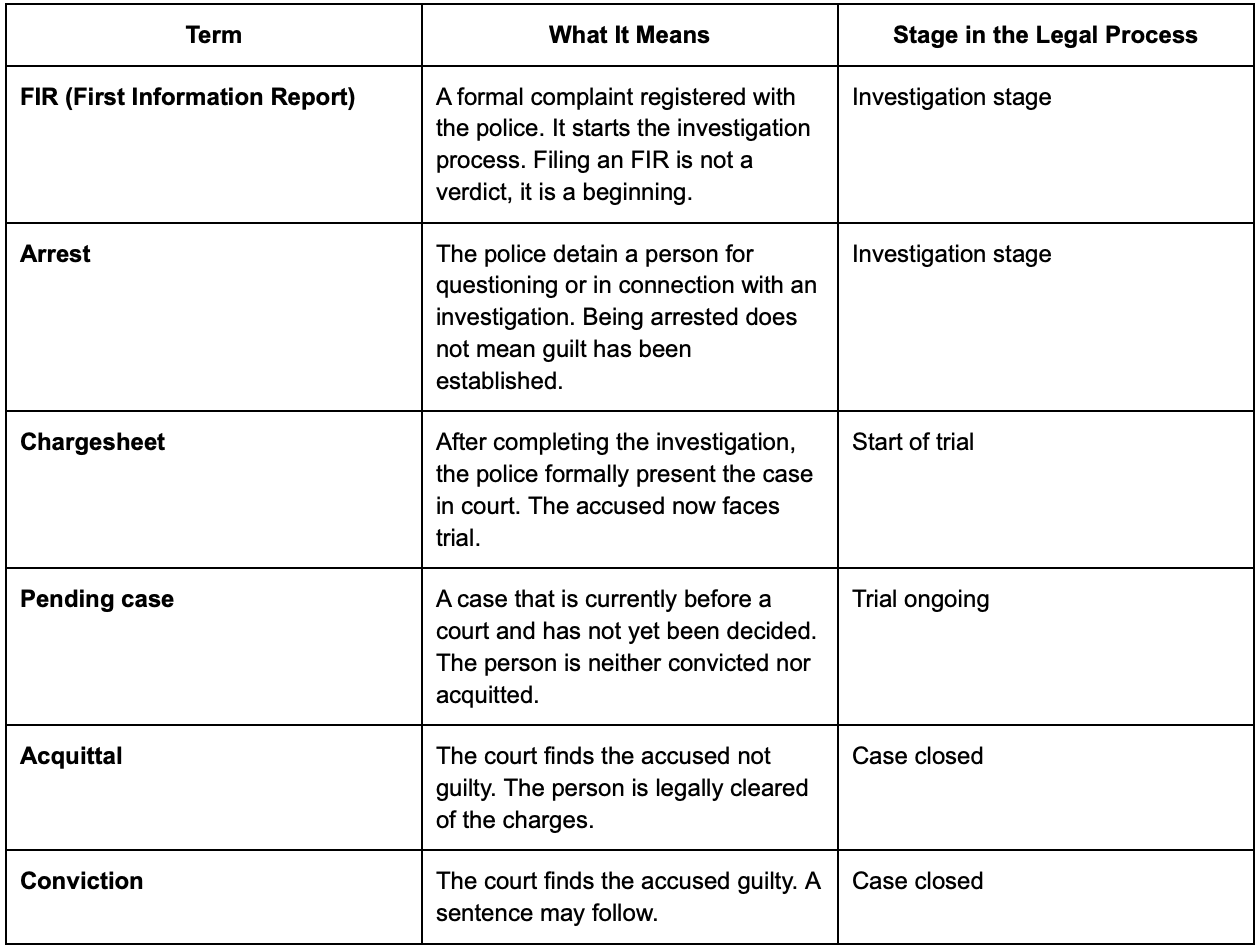
Key point: When a background verification surfaces a legal record, it is often identifying a pending case or past proceedings, not necessarily a conviction. The distinction is important.
Will a Pending Court Case Automatically Disqualify You?
No. A pending court case does not automatically disqualify someone from employment in India.
A pending case simply means the matter is still being heard and no final decision has been reached. Indian law recognises the principle of presumption of innocence until proven guilty.
In practice, employers make decisions based on factors such as:
• The nature of the case
• The seriousness of the allegations
• The relevance of the matter to the role
• The industry involved
• Whether the candidate disclosed the matter honestly when asked
Because employers have different policies and risk appetites, the same case may be viewed differently by different organisations. What matters most is the context surrounding the case, not merely the existence of one.
How Different Types of Cases Are Usually Viewed
Not all court cases carry equal weight in a background check. The nature of the case makes a significant difference in how employers tend to interpret it.
Criminal cases - attract the most scrutiny, particularly if they involve allegations of fraud, theft, violence, or moral turpitude. Even a pending criminal matter can raise concerns, especially in regulated industries. That said, many employers distinguish between cases where a person is the complainant versus the accused, and between serious and minor allegations.
Civil disputes - including property disagreements, contractual disputes, and arbitration matters, are generally viewed as personal or business matters. Most employers treat these as separate from professional integrity unless fraud is alleged.
Family law cases - divorce proceedings, maintenance disputes, custody matters, are almost universally considered private matters and rarely influence a hiring decision on their own.
Cheque bounce cases - under Section 138 of the Negotiable Instruments Act are very common in India and are treated as financial disputes. For most roles, they do not automatically disqualify a candidate, but for positions in finance, banking, or senior management, employers may weigh them more carefully.
Property disputes - are often long-running inherited matters. Employers in most industries view these as civil and personal in nature.
Cybercrime allegations - are treated very seriously, particularly in IT and tech organisations. Even a pending case in this area can cause significant concern and scrutiny.
Employment-related litigation - for example, a wrongful termination dispute with a former employer, may be reviewed in the context of what happened, rather than treated as an automatic red flag.
The practical takeaway: context matters at least as much as the category of the case.
How Different Industries May View Pending Cases
The same pending case can be viewed very differently depending on the industry you are applying to. Here is a general overview:
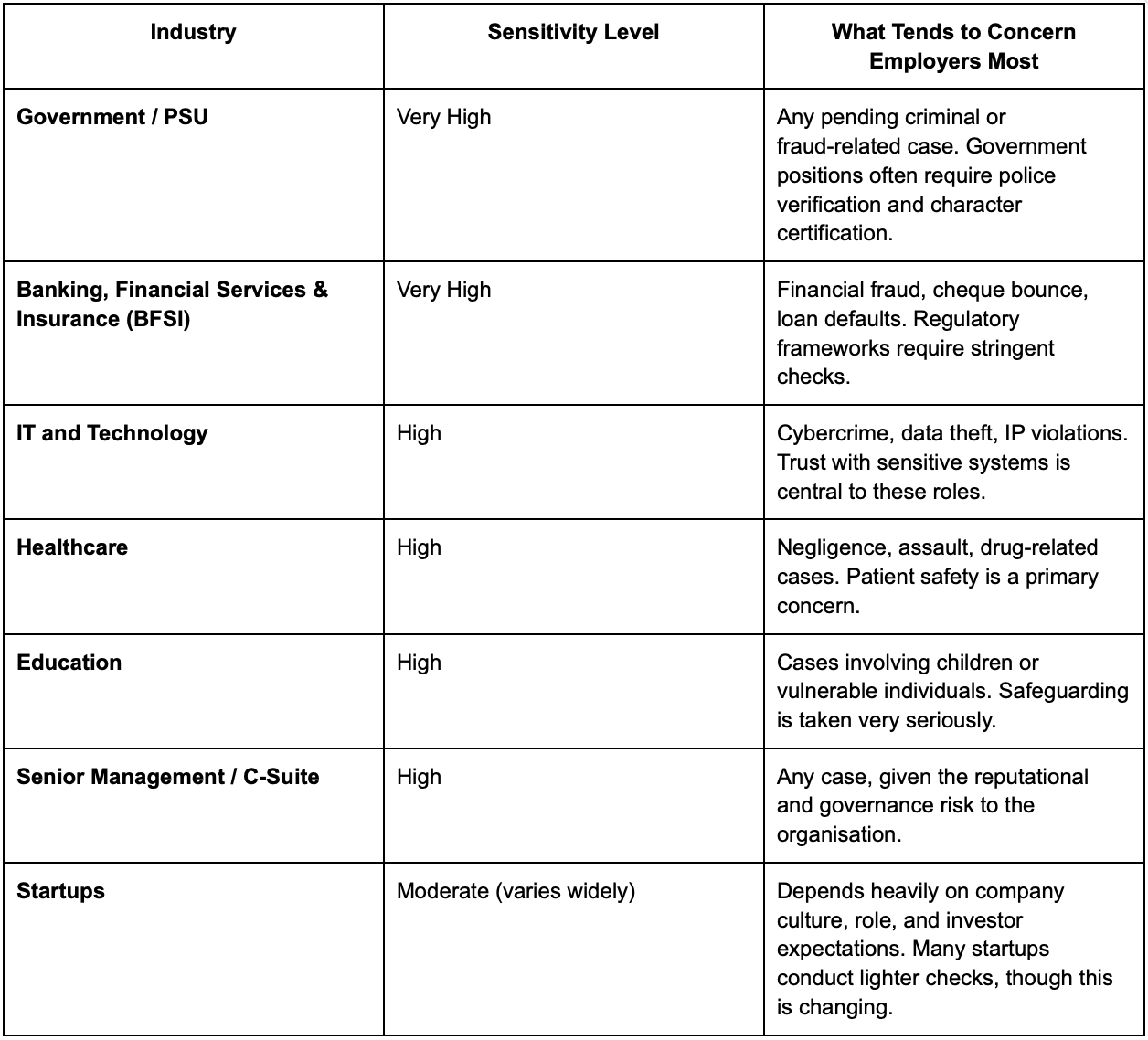
These are general tendencies and not universal rules. Every employer's policy is different.
What Employers Often Care About More Than the Case Itself
Experienced HR teams and background verification professionals often point out that what concerns them most is not always the case itself, it is the behaviour around it.
Honesty and disclosure: If an employment form asks whether you have any pending legal matters and you say no, then the BGV surfaces a case, that undisclosed information creates a serious credibility problem. In many cases, the concealment is treated as a bigger concern than the case itself.
Relevance to the role: A pending property dispute is unlikely to raise concerns for a data analyst role. A pending fraud case might be very relevant to a finance position. Employers assess relevance in context.
The seriousness of the allegations: There is a material difference between a minor civil complaint and a serious criminal allegation. Most employers, even those with strict policies, distinguish between these.
Current status of the proceedings: Is the case in its early stages? Has it been going on for years with no resolution? Has bail been granted? Has a charge been framed? These details may affect how the employer weighs the matter.
How you present it: Candidates who are calm, factual, and prepared when discussing a legal matter tend to be viewed more favourably than those who are evasive or defensive.
Common Misconceptions Worth Clearing Up
There is a lot of misinformation circulating about how background checks and court cases interact. Here are some of the most common misconceptions:
"Old cases won't show up." Court records, once entered into digital systems, remain publicly accessible. The age of a case does not guarantee it will be invisible.
"Civil cases never matter." While civil cases generally have less impact than criminal ones, cases involving fraud, financial dishonesty, or breach of trust can still influence hiring decisions in certain industries.
"An FIR means I am guilty." An FIR is a complaint. It starts an investigation. It does not establish guilt.
"Once I was acquitted, the record disappears." An acquittal is a court verdict in your favour, but the existence of the original case in public records may remain. Keeping your acquittal documentation is important.
"Employers cannot find court cases." Court data in India is typically digitised and accessible. Some background verification agencies may also conduct police verification or use additional databases depending on the employer and role.
"Not disclosing is the safer option." This is perhaps the most consequential misconception. Non-disclosure that is later discovered almost always creates more harm than honest disclosure upfront. Many employers view non-disclosure as a significant concern, particularly when the application specifically asks about pending legal matters.
What Should You Do If You Have a Pending Case?
This section is intended for general information and is not legal advice.
If you have a pending case and expect to undergo background verification:
• Understand the current status of your case so you can explain it accurately if asked.
• Keep important documents organised, including court orders and other relevant records.
• Answer application and verification questions honestly and accurately.
• Maintain records of significant developments in your case.
• Seek guidance from a qualified advocate if you are unsure about your rights or obligations.
Being informed and prepared can make the background verification process far less stressful.
How to Understand What an Employer May See During a Background Check
One of the most stressful parts of a background verification process is uncertainty. Many candidates simply do not know what information may be connected to their name in public court records until an employer brings it up.
Understanding your litigation history before a background check can help you avoid surprises, prepare accurate explanations if needed, and approach the process with greater confidence.
Court Click’s Legal Case Background Check feature is designed to make that easier. Instead of navigating multiple court systems and trying to piece together information yourself, Court Click compiles publicly available court records into a structured report that helps you understand the cases associated with a person or business, including the type of case, its current status, the court handling the matter, key case details, and other information that may be relevant during a background verification process.
For individuals preparing for employment background verification, this can be a practical way to understand what information may be visible before an employer conducts their own review.
If you are already involved in an ongoing case, Court Click can also help you stay informed. The platform allows you to track your case, receive updates on hearings and orders, and follow important developments without repeatedly checking public portals.
Whether you are preparing for a background verification, applying for a new job, conducting due diligence, or simply trying to stay informed about your own legal matters, having a clear picture of your litigation history can make the process far less uncertain.
Key Takeaways
- A pending court case does not automatically lead to employment rejection in India.
- Background verification in India may include searches of public court records and databases. Pending cases may be visible to employers.
- The type of case, its relevance to the role, the industry, and whether it was disclosed honestly are all factors employers consider.
- An FIR or a pending case is not a conviction. The presumption of innocence applies.
- Non-disclosure of a case that is later found is often treated as a more serious problem than the case itself.
- Self-verification before a BGV process can help you understand what information may be visible and feel more prepared.
- If your matter is complex, qualified legal guidance is always the right step.
Many people find it helpful to understand what information may be visible in public court records before a background verification process begins. Court Click's Legal Case Background Check and case tracking can help individuals stay informed and better prepared.
Frequently Asked Questions
1. Can I get a job with a pending court case in India? Yes, in many situations. A pending case is not a conviction, and private employers in India are not legally obligated to reject candidates on that basis alone. Employer decisions depend on the nature of the case, the role, and the industry. Honest disclosure and appropriate context matter significantly.
2. Can a civil case affect my employment? In most situations, civil cases such as property disputes or family matters have limited impact on hiring decisions. However, civil cases involving fraud, financial dishonesty, or breach of trust may be viewed with greater concern, particularly in certain industries.
3. Should I disclose a pending case to an employer? If the application form or employer specifically asks about pending legal matters, providing accurate information is strongly advisable. Non-disclosure that is later discovered through the BGV process can be treated as dishonesty, which is often viewed more seriously than the case itself.
4. Can employers see court records in India? Many court records in India are publicly accessible through court systems and legal databases. The extent to which a particular case is discoverable can depend on the court, case type, and level of digitisation.
5. Will an acquittal affect my background check? An acquittal is a legal finding in your favour, the court has determined you are not guilty. However, the existence of the original case in public records may remain visible. Keeping your acquittal documentation is advisable so you can provide it if questions arise.
6. Do startups care about pending cases? This varies considerably from company to company. Many startups conduct lighter BGV processes, but this is changing as startups scale and adopt more structured HR practices. Senior roles and roles involving access to sensitive data or finances tend to attract more scrutiny even at startups.
7. Can a cheque bounce case affect employment? It depends on the role and industry. For most non-financial roles, a cheque bounce case may not attract significant concern. For roles in banking, finance, or senior management, it may be reviewed more carefully as it relates to financial conduct.
8. Do government jobs check for pending cases? Government and PSU positions typically involve more thorough verification processes, including police character verification. Pending criminal cases, in particular, can significantly affect government hiring, though the specific impact varies by position, department, and the stage of proceedings.
9. What if my case is very old? Age alone does not guarantee a case will be invisible. Court records, once digitised, can be accessed regardless of when the case was filed. That said, context matters, an old case with no criminal conviction may be viewed very differently from a recent or ongoing serious matter.
10. Can I check my own litigation history? Yes. Court Click offers tools to search and track litigation history across courts, which can be useful for self-verification before a BGV process.
11. What happens if the employer finds a case I didn't disclose? The most common outcome is a deeper escalation by the BGV team and a likely direct conversation with the candidate. Depending on the employer's policy and the nature of the case, a job offer may be held or withdrawn, not necessarily because of the case, but because of the omission.
12. Does the BGV process differ for senior roles? Yes, meaningfully. Senior roles, particularly C-suite or leadership positions, often attract more comprehensive checks. This can include deeper civil litigation searches, media checks, director default checks, and more detailed reference conversations.
13. Is background verification legally required in India? There is no single law in India that mandates BGV across all employers. However, certain regulated sectors, banking, insurance, government contracting, have compliance requirements that effectively make verification necessary. Employers who do conduct BGV must obtain the candidate's consent and comply with applicable data protection rules.
Practical Disclaimer
This article is for informational purposes only. It does not constitute legal advice and should not be relied upon as a substitute for qualified legal counsel. The impact of a pending court case on employment in India varies significantly depending on the nature of the case, the employer, the industry, and individual circumstances. If you have a pending legal matter and concerns about how it may affect your employment, we recommend consulting a qualified advocate.