How to File an FIR in Kerala: A Step-by-Step Guide for Litigants (2026)
1. What is an FIR?
2. Who can file an FIR in Kerala?
3. Filing an FIR at a Kerala police station
3.1 What to include in your complaint
4. Filing an e-FIR Online Through the Thuna Portal
5. Zero FIR: Reporting Outside Your Local Station's Area
6. Your Rights When Filing an FIR
7. If the Police Refuse to Register Your FIR
8. Useful Official Resources
If you've witnessed a crime, been a victim of one, or simply need to report something to the police in Kerala, filing a First Information Report (FIR) is usually the first step. Most people walk into a station unsure of their rights, unsure what to say, and unsure what to do if the duty officer is reluctant to register the complaint as is often portrayed in movies.
This guide explains how FIR registration actually works in Kerala in 2026, both at the police station and online through the Kerala Police Thuna portal, under the current law: the Bharatiya Nagarik Suraksha Sanhita (BNSS), 2023, which replaced the old Criminal Procedure Code on 1 July 2024.
What Is an FIR?
An FIR (First Information Report) is the police's first written or electronic record of a cognizable offence, meaning a crime serious enough that police can investigate and arrest without prior court approval. Theft, assault, cheating, dowry harassment, cybercrime, and many other offences fall into this category.
For non-cognizable offences, such as defamation and certain minor offences, police can't register an FIR directly. They record it in a Non-Cognizable (NC) Register instead, and you'd need a magistrate's order before any investigation begins.
You don't need to figure out which category your case falls under before you go to the station. That's the duty officer's job. If you're unsure, go anyway.
Who Can File an FIR in Kerala?
You don't have to be the victim to file an FIR. Under Section 173 of the BNSS, any person with knowledge of a cognizable offence can file an FIR. This includes the victim, a witness, a family member or friend acting on the victim's behalf, or simply someone who became aware of the crime.
You also don't have to file at the station nearest to where the crime happened. More on that under Zero FIR below.
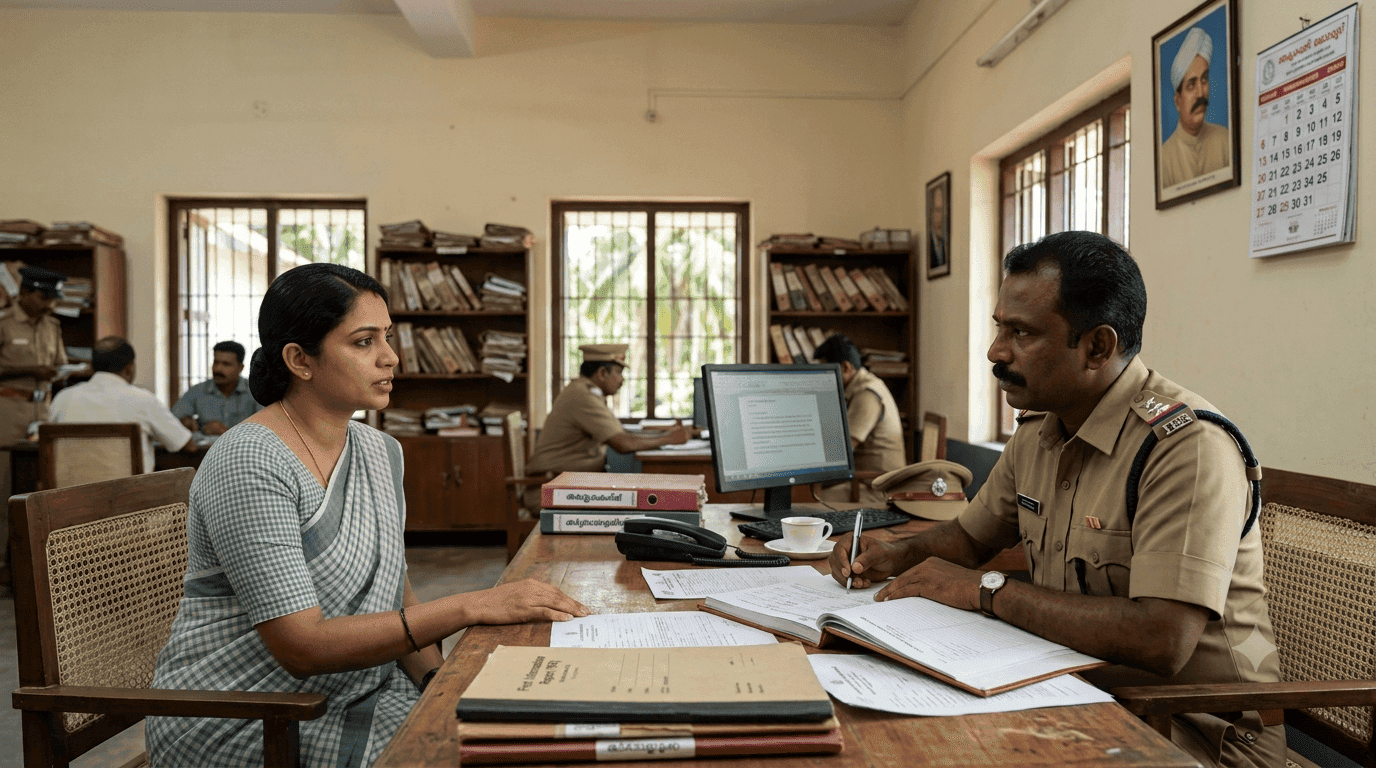
Filing an FIR at a Kerala Police Station
Go to the police station with jurisdiction over the area, or any station if you're filing a Zero FIR.
Narrate the incident to the officer in charge. State the date, time, location, the people involved, and what happened, in order.
If you give the information orally, the police must write it down and read it back to you. If you're submitting it in writing, sign every page.
Sign the recorded statement only once you've checked every detail is correct. Don't sign anything you haven't fully read.
Collect your free copy of the FIR. You're entitled to one at no cost, right after registration.
Note the FIR number, the station name, and the date. You'll need these for any follow-up, bail application, or court proceeding.
What to Include in Your Complaint
A well-documented complaint is harder to dispute later. Try to cover:
• Your full name, address, and other contact details
• The exact date, time, and location of the incident, the more precise, the better
• A clear, chronological account of what happened
• Details of the accused, if known: name, address, vehicle number, or any other identifying detail you have like physical appearance, even if only partial. If the accused is unknown, say so clearly. You can still file.
• Details of any witnesses
• A list of the evidence you're providing: photos, documents, medical reports, CCTV references, screenshots, and so on
Filing an e-FIR Online Through the Thuna Portal
Kerala Police's citizen portal, Thuna, allows citizens to submit complaints electronically. Where the complaint discloses a cognizable offence, it may be treated as information for FIR registration in accordance with Section 173 BNSS.
Visit the official Thuna portal or use the POL-APP mobile application.
- Create an account or log in.
- Select "New Complaint." Make sure your profile details are up to date.
- Fill out the form with full incident details, including accused details: name, address, vehicle number, or anything else you know about the person you're complaining against. If the accused is unknown, say so in the narrative. FIRs against unknown persons are routinely registered, though exact field behaviour on the portal can vary, so check with the station if it isn't obvious.
- Upload supporting documents: proof of identity, proof of address, and any evidence.
- Submit the complaint and note your reference number.
- Under Section 173(1) BNSS, information submitted electronically must be signed by the informant within three days. The police station will inform you of the verification or signature process applicable in your case.
Fill in the accused details as precisely as you can. A vague entry like "a man on a bike" slows things down. Specifics such as a vehicle number, workplace, social media handle, or last known address help the investigating officer move faster, and they matter later if the case goes to court.
You can also use the portal to track your FIR status or download a copy, using the FIR number, year, district, and station.
Zero FIR: Reporting Outside Your Local Station's Area
Many people don't realise this: you're not restricted to the police station that has jurisdiction over the crime scene.
Under Section 173(1) of the BNSS, any police station in India can register a Zero FIR for a cognizable offence, regardless of where the offence occurred. The police station receiving the complaint must record the information and then transfer the case to the police station having territorial jurisdiction to investigate the matter. This ensures that victims can report serious offences without delay, even when they are away from the place where the incident took place.
This is useful if you're reporting something that happened while travelling, if you're an NRI, or if you're a Keralite living abroad who needs to report an offence committed in India.
Your Rights When Filing an FIR
• The right to receive a free copy of the FIR immediately after registration in accordance with section 173(2) BNSS.
• The right to provide information electronically in accordance with Section 173 BNSS, including through approved electronic means.
• Special protections if you're a woman complainant. For certain offences against women, the information must generally be recorded by a woman police officer, with extra sensitivity in how the statement is taken.
• The right to escalate if the police refuse to act.
If the Police Refuse to Register Your FIR
This happens more often than it should, but the law gives you a clear path.
Approach the Superintendent of Police: Under Section 173(4) of the BNSS, if an officer refuses to register your complaint, you can send the substance of it in writing, by post, to the SP of the district. If the SP finds that a cognizable offence is disclosed, they must investigate it themselves or assign it to another officer.
Approach the Magistrate: If the SP also fails to act, Section 175(3) of the BNSS lets you file a sworn application before the jurisdictional Magistrate, asking for a direction to register the FIR and investigate. You'll typically need to show proof that you approached the police and the SP first, along with a supporting affidavit.
File a writ petition: In serious cases of continued inaction, you can, through an advocate, approach the Kerala High Court.
Refusing to register information disclosing a cognizable offence may amount to a breach of statutory duty and can expose the officer to disciplinary consequences. In certain cases involving specified offences against women, Section 199 of the Bharatiya Nyaya Sanhita, 2023, also provides criminal penalties for failure to record such information.
Useful Official Resources
• Kerala Police citizen services portal (Thuna): online FIR filing, status tracking, and copy downloads
• Kerala Police POL-APP mobile application
• Your local police station or District Superintendent of Police office
• Kerala State Legal Services Authority, for free legal aid if you can't afford a lawyer
When an FIR Leads to a Court Case
An FIR is often only the beginning of the legal process. Depending on the investigation and the nature of the offence, the matter may later proceed before a court through criminal proceedings, bail applications, trial, appeals, or other legal processes.
Once a court case is registered, keeping track of hearing dates, orders, and case progress can become challenging, especially for litigants who are unfamiliar with the court system.
If you have a court case, Court Click makes it easy to stay updated. Simply add your case to the app and receive important updates directly on your phone, including hearing dates, case status updates, uploaded orders, judgments, and other key developments. Instead of repeatedly checking court websites or following up for updates, you can track your case from one place and stay informed throughout the proceedings.
This article reflects FIR procedure under the BNSS, 2023, as applicable in Kerala. Procedures and portal interfaces change from time to time, so check the official portal or your nearest station for the latest process.