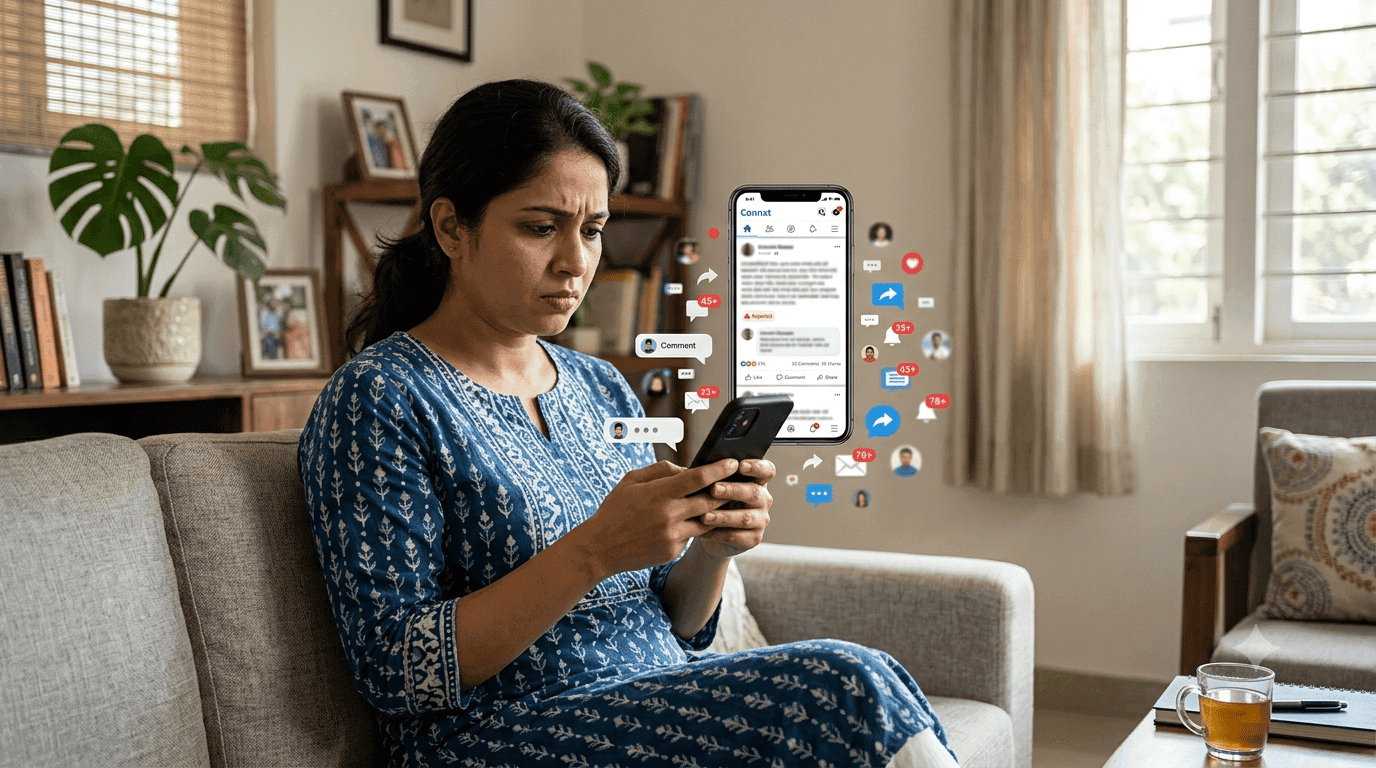
What counts as online defamation in India?
If a person posts a false and harmful statement about you online, Indian law does give you remedies. But Indian law also protects lawful criticism, reporting and opinion. That balance is the centre of the law on online defamation and social media liability. The most important thing to understand is that not every harsh social media post becomes defamation, and not every online complaint automatically makes Instagram, Facebook, YouTube, WhatsApp, or X legally responsible. False accusations online, fake social media posts, online harassment complaints, and fake post legal action are becoming more common across India.
Many readers still search for IPC sections 499 and 500. That is understandable, because older cases and many legal articles still use the Indian Penal Code language. But under the current criminal code, the main defamation provision is section 356 of the Bharatiya Nyaya Sanhita, 2023, which repealed the IPC and carries forward the offence, its explanations, its exceptions and the related offences for printing and selling defamatory matter. Terms like IPC 499 social media, online defamation India, fake allegations online, cyber complaint India, and social media legal action India are now commonly connected with these laws.
Under section 356 BNS, a person defames another person if they make or publish statements that harm someone’s reputation or are likely to damage their image in society. The law can apply to direct statements, fake stories, edited photos, videos, memes, and even indirect comments. In simple words, the law deals with false information that lowers someone’s image in the eyes of others. This may include fake Instagram pages, fake rumours on WhatsApp, YouTube videos spreading lies, fake Facebook posts, or someone ruining your reputation online.
However, Indian law also recognises important protections and exceptions. Truth alone is not always enough in criminal defamation. The statement must also be made for the public good. Honest criticism, fair opinions, good-faith complaints, and genuine public discussion are usually protected. For example, people can still give honest reviews, discuss public issues, or criticize government actions in good faith. This is important because not every online insult, bad comment online, or criticism becomes a defamation case in India.
Free speech still matters strongly. In Shreya Singhal v Union of India on 24 March 2015, the Supreme Court said that speech moves through three stages: discussion, advocacy and incitement. Mere discussion and advocacy, even if unpopular, stay protected. It is only when speech reaches the point of incitement that Article 19(2) restrictions become relevant. In the same case, the Court struck down section 66A of the IT Act because it was vague, overbroad and had bad implications on lawful expression. So, section 66A should not be treated as a valid basis for action today.
Which laws apply to social media posts?
At the same time, in Subramanian Swamy v Union of India, the Supreme Court upheld criminal defamation laws and said that reputation is part of a person’s dignity under Article 21 of the Constitution. In simple terms, Indian law protects both free speech and personal reputation.
Questions around legal action for fake posts, online abuse, cyber complaints, and social media harassment continue to grow because of this balance.
When platforms can be liable?
For social media platforms and online intermediaries, the key legal provision is section 79 of the IT Act. This section gives platforms limited legal protection for content posted by users, but only if the platform follows proper legal procedures and does not actively participate in unlawful activity. The protection is lost if the intermediary conspires, aids or promotes the unlawful act, or if it fails to act in situations covered by law. In Shreya Singhal, the Supreme Court read down section 79(3)(b), holding that “actual knowledge” for this purpose means knowledge from a court order or a lawful government notification relating to Article 19(2)-type grounds. This was meant to stop platforms from becoming private censors based on vague complaints alone.
The Intermediary Guidelines and Digital Media Ethics Code Rules, 2021, as amended and now available in consolidated form, add the compliance machinery around section 79. The current text requires intermediaries to publish their user rules and grievance system prominently, publish them in English or an Eighth Schedule language, acknowledge complaints within 24 hours, resolve complaints generally within 7 days, and act within 3 hours for specified removal requests under rule 3. Large social media companies must also appoint compliance officers in India and publish monthly compliance reports. These rules matter when trying to report online abuse, remove fake content online, report fake Instagram accounts, or deal with WhatsApp harassment complaints.
The case law on platform liability is important because it shows how courts apply these laws in real disputes. In the Myspace case (2016), the Delhi High Court said platforms only need to remove content when they receive a clear and specific notice, and they do not have to monitor everything posted online. In the Kent RO case (2017), the Court also refused to place a general screening duty on intermediaries. In Christian Louboutin (2018), the Delhi High Court said that an e-commerce platform acting as an active participant, rather than a passive platform, may lose protection under Section 79 of the IT Act. In the Ramdev judgment (2019), the Court allowed blocking of specific URLs in a defamation case and, in some situations, ordered global disabling of content uploaded from India. In Google India v Visaka Industries, the Supreme Court said the older pre-2009 version of Section 79 did not protect intermediaries from IPC defamation claims and held that key factual issues should be decided at trial instead of dismissing the complaint early.
How to remove defamatory content online?
Another important free-speech case is Anuradha Bhasin v Union of India on 10 January 2020. It was not a defamation case, but it matters for online speech because the Supreme Court clearly said that freedom of speech and expression through the internet is an integral part of Article 19(1)(a), and that internet restrictions must satisfy constitutional standards, including proportionality. For anyone thinking about blocking, takedowns and online speech controls, this case is part of the constitutional background.
So, what can a person do if they are targeted online? In practice, there are four common routes.
- Criminal complaint: the person aggrieved can file a criminal defamation complaint before the Magistrate. Older cases discuss this through IPC sections 499 and 500 and section 199 of the CrPC; the substance now sits in BNS section 356. The present punishment for defaming another under section 356(2) can extend to two years’ simple imprisonment, or fine, or both, or community service. Printing or selling defamatory matter also carries punishment.
- Civil suit: a person can seek an interim injunction, permanent injunction, takedown directions, damages and other relief. Indian courts have granted URL-based relief and wider disabling directions where the harm was ongoing and properly evidenced.
- Platform complaint or legal notice: a complainant can use the intermediary’s grievance channel and send a legal notice describing the content, the falsity, the harm and the exact links. This is often the fastest first step.
- Government blocking in rare cases: section 69A of the IT Act exists and was upheld in Shreya Singhal, but it is a public-law blocking power with safeguards. It is not the ordinary first remedy for a private defamation dispute between two individuals.
If you are a user who wants content removed, your evidence package matters a lot. Save screenshots, but also save the exact URL, the account handle, date and time, profile link, reposts or shares, comments showing spread, and any proof that the statement is false or misleading. If the post later disappears, your record may become the most important part of the case. Indian intermediary cases repeatedly show that precise links and precise identification of the material matter much more than generic allegations.
Takedown and notice-and-takedown
If you receive a defamation notice, do not reply in anger on the platform itself. First preserve the post, comments, metadata and your own draft or source material. Then ask: is the statement fact or opinion, is it true, is there supporting material, was it made in good faith, and does any statutory exception apply? If the post is obviously wrong or unnecessary, quick corrective action may reduce risk. If the post is defensible, a measured written response is usually better than a public fight. In either case, avoid deleting evidence before you understand the legal position.
The penalties side is straightforward in criminal law. Under section 356(2) BNS, defamation can lead to simple imprisonment up to two years, fine, both, or community service. Printing or engraving matter known to be defamatory and selling such matter with knowledge also carry punishment up to two years. In civil law, the bigger practical risk is often an interim injunction that stops publication or forces prompt takedown while the case is still pending.
The balance in Indian law is important. If the law is too weak, people may suffer serious harm from fake allegations, online harassment, fake posts, and reputation damage. If the law is too broad, it may discourage journalism, criticism, satire, whistleblowing, and honest public discussion. Indian courts have repeatedly tried to balance both concerns. The practical position today is clear: honest criticism and good-faith opinion are generally protected, but false and harmful statements online can still lead to serious legal consequences. That is why understanding online defamation law in India, cyber police complaints, social media liability, fake post legal action, online harassment laws, and WhatsApp defamation complaints is becoming more important every year.
This article is for general information and legal awareness. It is not a substitute for advice on the facts of a specific case.