
What Is a Legal Notice? A Simple Guide for Litigants in India
Quick Answer: A legal notice is a formal written communication sent by one party to another before approaching a court, explaining the legal grievance and giving the recipient an opportunity to respond or resolve the dispute. It's compulsory in specific situations, like suing the government or a public officer, or filing a cheque bounce case, and optional (though common) in most other civil disputes such as money recovery, property, and contract matters.
If you've received a legal notice, or you're thinking about sending one, the process can feel intimidating. It shouldn't be. A legal notice is simply a formal way of saying "here's the problem, and here's what I want you to do about it, before this goes to court." This guide breaks down what it means, when it's actually required by law, and what to do next.
What Is a Legal Notice?
A legal notice is a written communication, usually sent through an advocate, that tells someone about a legal grievance and asks them to resolve it within a fixed time, failing which the sender will approach a court. It typically covers who is sending it, what went wrong, what the sender wants (money, an action, an apology, possession of property), and a deadline to respond.
Advocates commonly send one for a simple reason: it's often the cheapest, fastest way to resolve a dispute. In many disputes, a legal notice encourages the other side to negotiate or settle the matter without going to court, saving both parties time and legal expenses. It also creates a paper trail, proof that a genuine attempt was made to resolve things before court, which can matter later if the case does go to trial.
Is a Legal Notice Compulsory?
Not always. In India, a legal notice is mandatory only in certain situations specifically provided by law. In many other civil disputes, it is optional, though often recommended.
Suits against the Government or a Public Officer
Under Section 80 of the Code of Civil Procedure, 1908, a person who intends to sue the Central Government, a State Government, or a public officer for acts done in their official capacity must generally serve a written legal notice and wait two months before filing the suit. If this requirement is not followed, the suit is ordinarily not maintainable. However, where urgent or immediate relief is required, the court may permit a suit to be filed without serving the notice, subject to the conditions laid down in the CPC.
Cheque Bounce Cases
Under Section 138 of the Negotiable Instruments Act, 1881, if a cheque is dishonoured, the payee must send a written demand notice to the drawer within 30 days of receiving information about the dishonour. The drawer then has 15 days to make payment. If payment is not made within that period, the cause of action arises to file a criminal complaint. Without serving this statutory notice, proceedings under Section 138 generally cannot be maintained.
Certain Commercial Disputes
Under the Commercial Courts Act, 2015, many commercial disputes of the prescribed value require pre-institution mediation before a suit can be filed, unless the plaintiff seeks urgent interim relief. This mediation requirement is separate from a legal notice, although parties often exchange legal notices before initiating mediation or litigation.
When a Legal Notice Is Optional
For most other civil disputes, including money recovery, property disputes, contract disputes, landlord-tenant disagreements, employment disputes, and many consumer disputes, a legal notice is generally not compulsory. However, it is widely used because it gives the other side an opportunity to resolve the dispute without litigation and creates a written record showing that an attempt was made to settle the matter before approaching a court.
A Common Misconception
Many people believe a legal notice is compulsory before filing any civil case. That is not correct. For example, disputes involving unpaid personal loans, breach of contract, defective work by a contractor, or many landlord-tenant disagreements usually do not legally require a notice before filing a suit. Even so, advocates often recommend sending one because it may encourage an early settlement and helps document the parties’ positions before litigation.
When Is a Legal Notice Commonly Sent?
- Legal notices are commonly used before civil litigation in situations such as:
- * Money recovery - when a friend, customer, client, or business owes you money and has failed to repay it despite reminders.
- * Consumer disputes - where a defective product was supplied, services were deficient, or a promised refund was not made.
- * Property disputes - such as delays in handing over property, illegal construction on your property, disputes over partition of family property.
- * Contract disputes - where one party has failed to perform their contractual obligations, missed agreed deadlines, or breached the terms of an agreement.
- * Employment disputes - including claims relating to unpaid salary or benefits, wrongful termination, or notice period disputes.
- * Landlord-tenant disputes - such as demanding vacant possession of rented premises, recovery of unpaid rent, or return of a security deposit.
- * Family and matrimonial disputes - including maintenance demands, matrimonial disagreements, or as part of attempts to resolve disputes before litigation.
- * Civil defamation - where a person seeks a retraction, apology, or compensation for false statements before filing a civil suit for damages.
- *In many of these situations, a legal notice is not mandatory. It is often used because it gives the other party an opportunity to resolve the dispute before court proceedings begin.
What Does a Legal Notice Usually Contain?
While the exact format varies depending on the dispute, a legal notice typically includes:
- Date and Subject Line - The date of the notice and a clear subject line summarising the dispute.
- Details of the parties - The names, addresses, and identifying details of the sender and recipient.
- Background facts - A clear, chronological account of the events leading to the dispute.
- The legal grievance - The legal right, contractual obligation, or duty that the sender believes has been violated.
- The relief sought - What the sender expects the recipient to do, such as pay money, vacate property, perform an obligation, or issue an apology.
- A deadline to respond or comply - A reasonable time for the recipient to respond or resolve the dispute. In many civil matters this is commonly 15–30 days, unless a statute prescribes a specific period.
- A warning of legal consequences - A statement that legal proceedings may be initiated if the recipient fails to comply within the specified time.
- Signature and contact details - If issued through an advocate, the notice usually includes the advocate’s name, signature, address, and contact details. Individuals may also send legal notices themselves.
How Is a Legal Notice Sent?
A legal notice may be sent either by the person concerned or through an advocate. Although the law does not always require an advocate to issue the notice, notices sent through advocates are often taken more seriously because they indicate that the sender has obtained legal advice and may be prepared to initiate legal proceedings if the dispute is not resolved.
Legal notices are commonly sent through Registered Post with Acknowledgement Due (RPAD) or Speed Post, as these methods create reliable proof of dispatch and delivery. Depending on the circumstances, notices may also be sent by email or WhatsApp, particularly where there is evidence that the recipient received or viewed the notice. In practice, many advocates use more than one mode of service, such as RPAD together with email or WhatsApp, to strengthen proof that the notice reached the recipient.
Whatever method is used, preserve proof of dispatch and delivery. Postal receipts, acknowledgement cards, courier records, email delivery confirmations, and WhatsApp delivery or read receipts may become important evidence if the dispute later reaches court.
What Should I Do After Receiving a Legal Notice?
Receiving a legal notice does not automatically mean you have done something wrong or that a case has already been filed against you. It is an opportunity to understand the other party’s claims and respond before litigation begins.
If you receive a legal notice:
- Read it carefully. Understand the allegations, the relief being sought, and any deadline for responding.
- Preserve relevant documents. Keep contracts, invoices, receipts, emails, messages, photographs, or any other material that supports your version of events.
- Do not ignore it. Ignoring a legal notice does not automatically mean you admit the claims against you. However, depending on the facts of the case, your failure to respond may be considered by the court when assessing the conduct of the parties. It also means you lose an opportunity to present your version or resolve the dispute before litigation begins.
- Consult an advocate before replying. A reply notice can become important evidence if the matter later reaches court. It should be carefully drafted, as statements made in the reply may be relied upon during future legal proceedings.
Can You Ignore a Legal Notice?
Technically, yes. There is no law that forces you to reply to every legal notice. However, ignoring one is rarely a good idea.
If the sender decides to file a case, your silence may be relied upon to show that they made a genuine attempt to resolve the dispute before approaching the court. While simply ignoring a legal notice does not automatically mean you admit the allegations or lose your case, it may weaken your position depending on the facts and deprive you of the opportunity to explain your side early.
In some matters, such as cheque bounce cases under Section 138 of the Negotiable Instruments Act, failing to comply with the statutory demand notice within the prescribed time allows the complainant to initiate criminal proceedings. Responding promptly and seeking legal advice is therefore important.
Common Misconceptions About Legal Notices
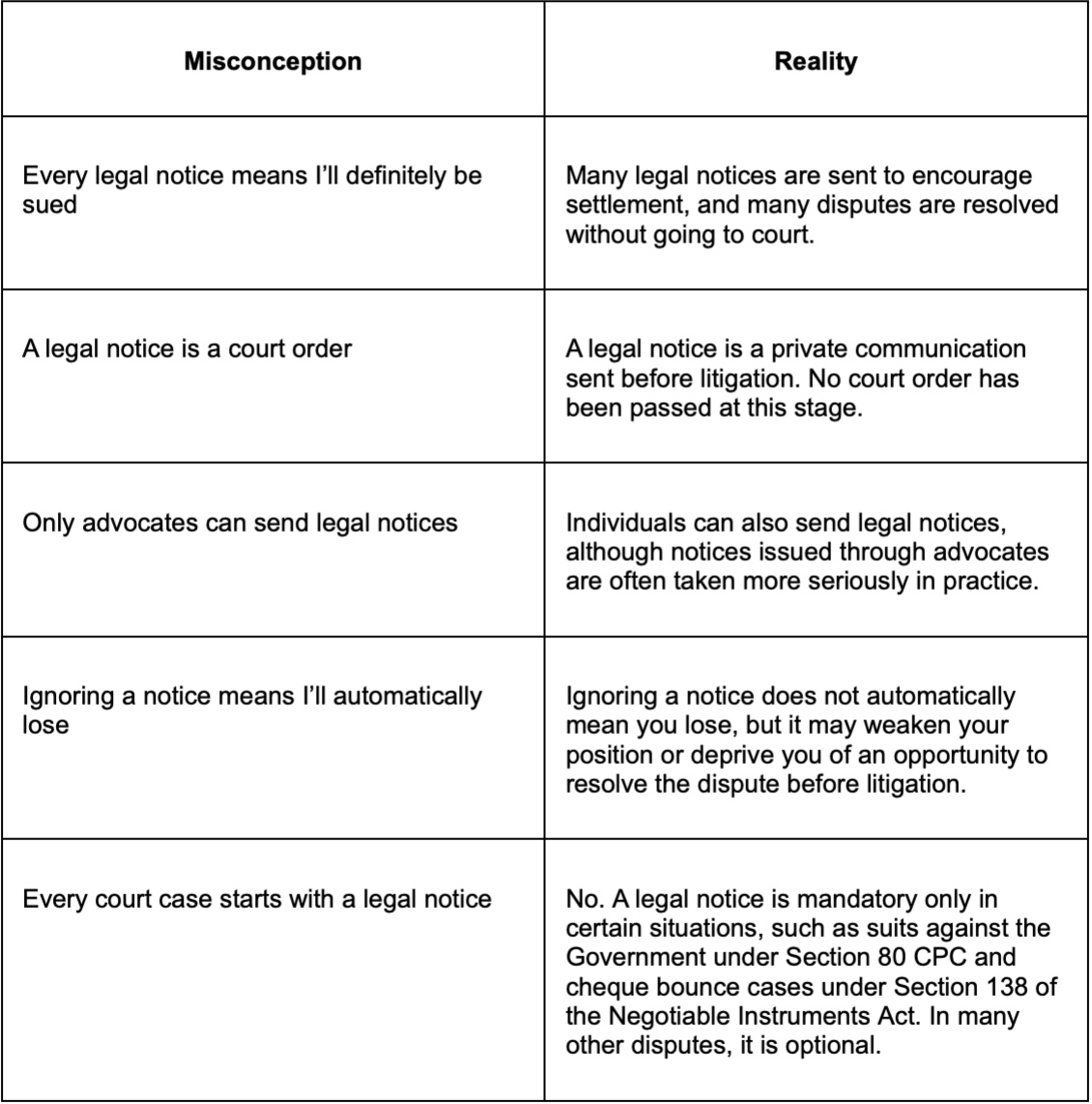
Key Takeaways
- A legal notice is a formal pre-litigation communication, not a court order. It gives the other party an opportunity to resolve a dispute before legal proceedings begin.
- A legal notice is legally mandatory only in certain situations, such as suits against the Government under Section 80 of the Code of Civil Procedure, cheque bounce cases under Section 138 of the Negotiable Instruments Act, and certain commercial disputes requiring pre-institution mediation.
- In most other civil disputes, sending a legal notice is optional but often advisable, as it may encourage settlement and create a record of your attempt to resolve the dispute.
- If you receive a legal notice, read it carefully, preserve all relevant documents, and consult an advocate before deciding how to respond.
How Court Click Can Help
A legal notice is often the first step in a dispute. If that dispute later becomes a court case, keeping track of hearing dates, interim orders, and judgments can quickly become difficult.
Court Click helps litigants stay informed without having to repeatedly check websites or call their advocate for updates. Once your case is added, you receive real-time notifications whenever there’s a hearing date, hearing update, order, or judgment uploaded to the court system. You can also view your case timeline in one place and apply for a Certified True Copy (CTC) of your judgment or court orders directly through the app.
Frequently Asked Questions
1. What is a legal notice in simple terms?
A legal notice is a formal written communication informing someone about a legal grievance and giving them an opportunity to resolve the dispute before court proceedings are initiated.
2. Is it mandatory to send a legal notice before filing a case in India?
Only in certain situations, such as suits against the Government under Section 80 of the Code of Civil Procedure, 1908, cheque bounce cases under Section 138 of the Negotiable Instruments Act, 1881, and certain commercial disputes that require pre-institution mediation. In most other civil disputes, it is optional.
3. How long do I have to respond to a legal notice?
There is no fixed legal time limit in most civil matters. The sender usually specifies a reasonable period, commonly between 15 and 30 days, unless a statute prescribes a different timeline, such as the 15-day period under the cheque bounce provisions.
4. Do I need a lawyer to send a legal notice?
No. You may send a legal notice yourself. However, notices issued through an advocate are often taken more seriously and are generally drafted to clearly set out the legal issues.
5. What happens if the other party doesn’t reply to my legal notice?
You may proceed with appropriate legal proceedings if the dispute remains unresolved. The notice also serves as evidence that you attempted to resolve the matter before approaching the court.
6. Is a legal notice the same as a court summons?
No. A legal notice is a communication between parties before litigation. A court summons is issued by a court after a case has been filed.
7. Can a legal notice be sent by email or WhatsApp?
Depending on the circumstances, courts have recognised service through electronic means such as email and WhatsApp where receipt can be established. Many advocates also send notices through RPAD or Speed Post in addition to electronic modes.
8. What should I do if I receive a legal notice for something I don’t owe or didn’t do?
Read the notice carefully, preserve all relevant documents, and consult an advocate before sending a reply. A well-prepared response may help clarify your position and avoid unnecessary litigation.
9. Does sending a legal notice guarantee I’ll win my case?
No. A legal notice is only a pre-litigation step. Whether you succeed ultimately depends on the law, the evidence, and the facts proved before the court.
10. Is a legal notice required before filing a consumer complaint?
Generally, no. The Consumer Protection Act, 2019 does not make a legal notice mandatory before filing a consumer complaint. However, sending one is common practice and may help resolve the dispute without litigation.
Disclaimer: This article is intended for general informational and educational purposes only and does not constitute legal advice. The applicable law and the appropriate legal remedy depend on the facts of each case. Before taking legal action or responding to a legal notice, consult a qualified advocate for advice specific to your situation.