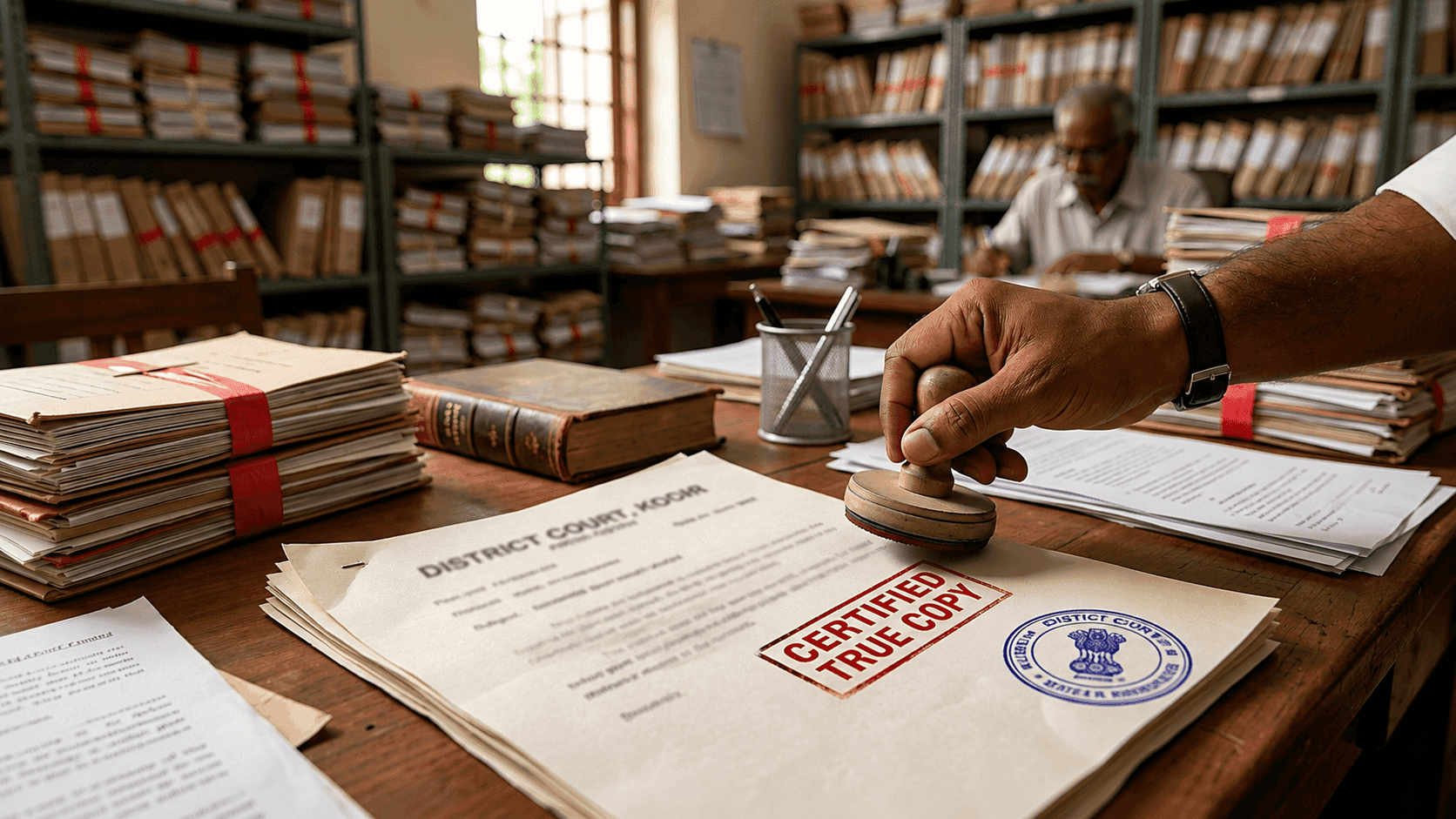
What Is a Certified True Copy (CTC) and Why Does Every Litigant Need One?
A judgment has been delivered. An important interim order has been passed. Your advocate calls and says: “Apply for the Certified True Copy."
And right there, many litigants stop and wonder, what exactly is a CTC? Why can't I just use the PDF the court uploaded? Is a downloaded copy not enough? Do I really need to apply for something separately?
These are completely reasonable questions. Most litigants only discover what a Certified True Copy is after an important order has already been passed, when time is short and every step matters. This guide explains exactly what a CTC is, why courts and other authorities require it, when you should apply, and how you can get one without unnecessary hassle.
QUICK ANSWER
A Certified True Copy (CTC) is the official court sealed and stamped copy of a court document, such as a judgment or order, issued directly by the court.
It carries the court's authentication (typically a judicial seal, and authorised signature).
A CTC is often required for filing appeals, executing court decrees, completing official formalities, and producing court records before government bodies, tribunals, or other authorities. A downloaded PDF from a website and a Certified True Copy are not always treated the same for official purposes.
What Is a Certified True Copy (CTC)?
When a court passes an order or delivers a judgment, that document becomes part of the court's official record. A Certified True Copy is an authenticated copy of that document, issued by the court itself, confirming that what you are holding accurately reflects the official record on file.
Think of it this way: the court's record is the original. A CTC is a formally verified reproduction of that original. The certification, typically bearing the court's seal, and signature, a declaration of accuracy. This is what distinguishes it from any other copy.
Courts issue certified copies because legal proceedings frequently require documentary proof that is officially verifiable. When a judgment needs to be enforced, when an appeal needs to be filed, or when a court record must be produced before another authority, the requirement is not just a copy of the document, it is a certified copy that the issuing court stands behind.
Downloaded Copy vs. Certified True Copy
This is the question most litigants get wrong. A downloaded PDF of a court order can be useful - for reading the judgment, sharing it with your advocate, or keeping a personal reference. But for most official purposes, it is not a substitute for a Certified True Copy.
The bottom line: a downloaded copy helps you read and understand the court’s decision. A Certified True Copy provides official authentication that the document matches the court’s record.
Which Court Documents Can Be Obtained as a CTC?
A Certified True Copy can typically be applied for in respect of the following types of court documents:
- Judgments - the final decision of the court disposing of a case
- Interim Orders - orders passed during the course of proceedings, such as injunctions, stay orders, or maintenance orders
- Final Orders - orders that conclude proceedings or decide specific applications
- Decrees - formal expressions of the court's decision in civil matters, which are required for execution proceedings
- Depositions and other procedural records - subject to the nature of the document and applicable court rule
Note: Availability and procedures can differ depending on the court (High Court, District Court, Family Court, etc.) and the nature of the document. For documents other than judgments and orders, additional conditions may apply under the relevant court rules.
Why Do Litigants Need a Certified True Copy?
A CTC is not a formality. In many situations, the absence of a Certified True Copy can directly delay or obstruct the next step in your case. Here are the main reasons litigants need one:
Filing an Appeal
When you wish to challenge a court order or judgment in a higher court, a Certified True Copy of the order being appealed is almost always required. A downloaded copy generally does not satisfy this requirement.
Executing a Decree
In civil matters, after a court passes a decree (for example, directing payment of money or delivery of property), a certified copy of the decree is required to initiate execution proceedings. Without it, the process of enforcing the court's decision cannot begin.
Property Matters
Court orders related to property, partition decrees, ownership declarations, injunctions, are often required by registration authorities, banks, or other parties. These authorities typically require a Certified True Copy, not a downloaded printout.
Family Court Matters
In divorce, custody, maintenance, and succession matters, certified copies of orders and decrees are frequently needed, for compliance, for further proceedings, for government offices, and for documentation purposes.
Criminal Proceedings
Accused persons, complainants, and other parties affected by criminal court orders are entitled to certified copies of judgments and relevant orders. These may be needed for bail applications, revision petitions, appeals, or other remedies.
Producing Records Before Another Authority
Government departments, tribunals, quasi-judicial bodies, banks, and employers may require certified copies of court orders as proof of ongoing litigation, case closure, legal status, or compliance.
Future Litigation and Official Records
Maintaining certified copies of important orders and judgments in your case is simply good practice. It ensures you have an authoritative reference available whenever a future need arises, without having to reapply to the court at a later date.
When Should You Apply for a CTC?
The short answer: as soon as possible after the relevant order or judgment is passed.
Here are the key moments when you should apply:
- After a final judgment - especially before considering an appeal
- After an important interim order - such as a stay, injunction, or maintenance order
- Before filing an appeal - courts require a certified copy, and time limits for appeals are strict
- When your advocate advises you to apply - follow this without delay
- When another authority requests a certified copy of a court order
- When you need to execute a decree or enforce a court direction
Why delays matter: If you are considering an appeal or any further legal action, waiting too long to obtain a Certified True Copy can create unnecessary delays. Different proceedings are governed by different limitation periods and procedural requirements. Obtaining the necessary documents promptly helps ensure that you are prepared to take the next step when required.
Can You Get a Certified True Copy Online?
Yes. One of the easiest ways for litigants to apply for a Certified True Copy (CTC) is through Court Click.
Instead of dealing with multiple steps, follow-ups, or visits to the court, Court Click allows users to request Certified True Copies directly through the app. Whether you need a judgment, an interim order, or another available court document, the application process can be completed from your phone.
This is particularly useful for:
• Litigants who live far from the court handling their case
• People who want to avoid repeated follow-ups
• Individuals managing multiple cases
• NRIs with cases pending in Kerala courts
Once the request is submitted, users can track the status of their application and receive the document when it becomes available. When the Certified True Copy is ready, it can be delivered to your doorstep or get it as an eCopy.
For many litigants, applying through Court Click is a simpler and more convenient way to obtain Certified True Copies without having to navigate the process on their own.
Common Misconceptions About Certified True Copies
MYTH: A DOWNLOADED PDF IS ALWAYS ENOUGH
Fact: A downloaded copy is useful for your own reference, but it is not a certified document. For appeals, execution proceedings, compliance with official directions, and submissions to authorities, a Certified True Copy is typically required.
MYTH: CERTIFIED COPIES ARE ONLY NEEDED FOR APPEALS
Fact: Appeals are one important use, but CTCs are also required for executing decrees, compliance with court directions, property registrations, family court formalities, producing court records before other authorities and more.
MYTH: EVERY ORDER AUTOMATICALLY COMES WITH A CERTIFIED COPY
Fact: Certified copies are not automatically issued. A party must apply for them, in the prescribed manner, and fees are payable. The court issues the certified copy only after the application is processed.
MYTH: A CTC IS UNNECESSARY ONCE A JUDGMENT IS UPLOADED ONLINE
Fact: Online availability of a judgment does not replace the Certified True Copy. The uploaded version is for public information. The CTC is the certified, authenticated copy of the official record, and courts, authorities, and appellate bodies require this, not a printout.
Key Takeaways
- A Certified True Copy is an officially authenticated copy of a court document, issued by the court itself.
- A downloaded PDF and a CTC are not the same for official or legal purposes.
- CTCs are required for appeals, execution of decrees, compliance with court orders, and submissions to official bodies.
- Apply for a CTC as soon as an important order or judgment is passed, especially if an appeal is being considered.
- Delays in applying can affect your limitation period for filing an appeal.
- Court Click allows litigants to apply for CTCs directly through the app, with delivery to your doorstep, useful for those living far from court, or NRIs with cases in Kerala.
Many litigants only realise they need a Certified True Copy after an important order or judgment has already been passed. Court Click helps users apply for Certified True Copies and stay informed about their cases — without unnecessary follow-ups or multiple court visits.
Frequently Asked Questions
What is a Certified True Copy (CTC)?
A Certified True Copy is an officially authenticated copy of a court document, such as a judgment, order, or decree, issued by the court. It bears the court's certification confirming that the copy accurately reflects the official court record.
Is a Certified True Copy different from a downloaded copy?
Yes. A downloaded copy is for reference only. A CTC is an officially certified document issued by the court, which is required for appeals, legal proceedings, and most official purposes.
Why do courts require certified copies?
Courts and authorities require certified copies because they need documentary proof that is verifiable and officially authenticated. A CTC provides assurance that the document accurately reflects the court's official record.
Can I get a certified copy of a judgment?
Yes. A final judgment is one of the primary documents for which a CTC can be applied. You can easily apply for it through Court Click and get it delivered to your doorstep.
Can I get a certified copy of an interim order?
Yes. Certified copies of interim orders, such as stay orders, injunctions, or maintenance orders, can be applied for in the same manner as other court documents. Court Click supports CTC applications for both judgments and interim orders.
Can I apply for a CTC without a lawyer?
A party to the proceedings is generally entitled to apply for a certified copy of their own case documents. Through Court Click, litigants can submit a CTC request directly, without having to individually navigate the court's copy application process.
Can NRIs obtain Certified True Copies of Kerala court orders?
Yes. Through Court Click, NRIs with cases in Kerala courts can apply for CTCs and have them delivered to their address, including international delivery options, without needing to travel to Kerala or arrange for someone to visit the court on their behalf.
Do I need a CTC to file an appeal?
In many cases, yes. Appeals before higher courts often require a Certified True Copy of the order or judgment being challenged, subject to the applicable procedural rules. Because appeals are governed by limitation periods and filing requirements, litigants who are considering an appeal should obtain the necessary documents and seek legal advice as early as possible.
Can I get a CTC online in Kerala?
Yes. Court Click allows litigants to apply for Certified True Copies (CTCs) directly through the app. Users can select the relevant case, choose the document they need, submit the request, track its status, and receive the document through available eCopy or physical delivery options. This makes the process simpler and more convenient, especially for litigants who live far from the court or have cases pending in different locations..
How long does it take to receive a CTC?
Processing times can vary depending on the concerned court.
Is a scanned copy of a court order legally valid?
A scanned copy may be useful for personal reference, but it is not the same as a Certified True Copy. For formal legal proceedings, official filings, and submission to authorities, a CTC from the issuing court is the appropriate document.
How does Court Click help with CTCs?
Court Click allows litigants to apply for Certified True Copies (CTCs) directly through the app. Users can select the relevant case, choose the document they need, complete the payment, track the status of the request, and receive the document through eCopy or physical delivery.
Disclaimer: This article is intended for general informational and educational purposes only. It does not constitute legal advice and should not be treated as a substitute for professional legal counsel. Procedures and requirements for obtaining Certified True Copies may vary across courts and are subject to applicable rules and regulations in force at the relevant time. Litigants are advised to consult their advocate for guidance specific to their case and court. Information in this article is provided as of the date of publication and may be subject to change.