How to File a Consumer Complaint in Kerala (2026): A Step-by-Step Guide
Quick Answer
Any consumer in Kerala who has paid for a defective product or a deficient service can file a complaint with the Consumer Disputes Redressal Commission. You can file online through the government's e-Jagriti portal (the platform that has replaced e-Daakhil) or offline at the District Consumer Commission covering your area. A lawyer is not compulsory, you can represent yourself. You have two years from the date the problem arose to file, and depending on the value of the goods or services paid as consideration, your case will go to the District, State, or National Commission. Common outcomes include a refund, replacement, repair, compensation, or reimbursement of your legal costs.
What Is a Consumer Complaint?
A consumer complaint is a formal grievance you raise with a Consumer Disputes Redressal Commission when a seller, manufacturer, or service provider has let you down, either through a defective product or a deficiency in service. It is different from a police complaint or a civil suit. It's a simpler, faster mechanism built specifically for these disputes, and you don't need a lawyer to use it.
Some everyday examples that qualify:
- A refrigerator or washing machine that stops working within the warranty period and the company refuses to repair or replace it
- A builder who delays handing over your flat well past the promised date
- An online order that never arrives, or arrives damaged, with no refund
- An insurance claim rejected without valid reason
- A bank that wrongly deducts charges and won't reverse them
- Poor treatment or billing disputes at a hospital
- A travel agency or airline that cancels a booking and refuses a refund
Who Can File a Consumer Complaint?
You don't have to be the only affected person to file. The law allows several categories of people to approach the Commission:
- The consumer themselves, anyone who bought goods or hired a service for consideration
- The legal heirs or representatives of a consumer who has passed away
- A recognised consumer association, on behalf of one or more consumers
- The Central or State Government, in certain situations
- A group of consumers who share the same grievance against the same opposite party, filed as a single complaint
- A parent or guardian filing on behalf of a minor
What Problems Can Be Taken to the Consumer Commission?
Broadly, you can approach the Commission for:
- Defective goods - a product that doesn't work as it should, or is faulty, damaged, or not as described
- Deficiency in service - poor, delayed, or incomplete service from a bank, hospital, builder, telecom provider, travel company, and so on
- Unfair trade practice - misleading claims, false representations, or deceptive sales tactics
- Overcharging - being billed more than the agreed or displayed price
- Misleading advertisements - claims about a product or service that turn out to be false
- Product liability - if a defective product causes injury or loss, you may be able to claim compensation from the manufacturer, seller, or service provider
For example, if a company sells you a mixer grinder that catches fire due to a manufacturing fault and you're injured, this isn't just a "defective goods" issue, it can also be pursued as a product liability claim.
Should You Contact the Business First?
Yes, it’s usually worth trying to resolve the issue directly with the business before filing a consumer complaint. Contact their customer care, raise a formal written complaint (email is often the best option because it creates a record), and give them a reasonable opportunity to resolve the issue.
Keep copies of everything, including complaint reference numbers, emails, screenshots of chats, invoices, and any replies you receive. Even if the business doesn’t resolve your complaint, these records can become valuable evidence if you later approach a Consumer Commission.
If you’re unable to resolve the issue directly with the business, you may also consider approaching the National Consumer Helpline (NCH), which provides a platform for consumers and businesses to attempt an amicable resolution before formal proceedings. If the dispute remains unresolved, you can then file a complaint before the appropriate Consumer Commission.
Is Sending a Legal Notice Compulsory?
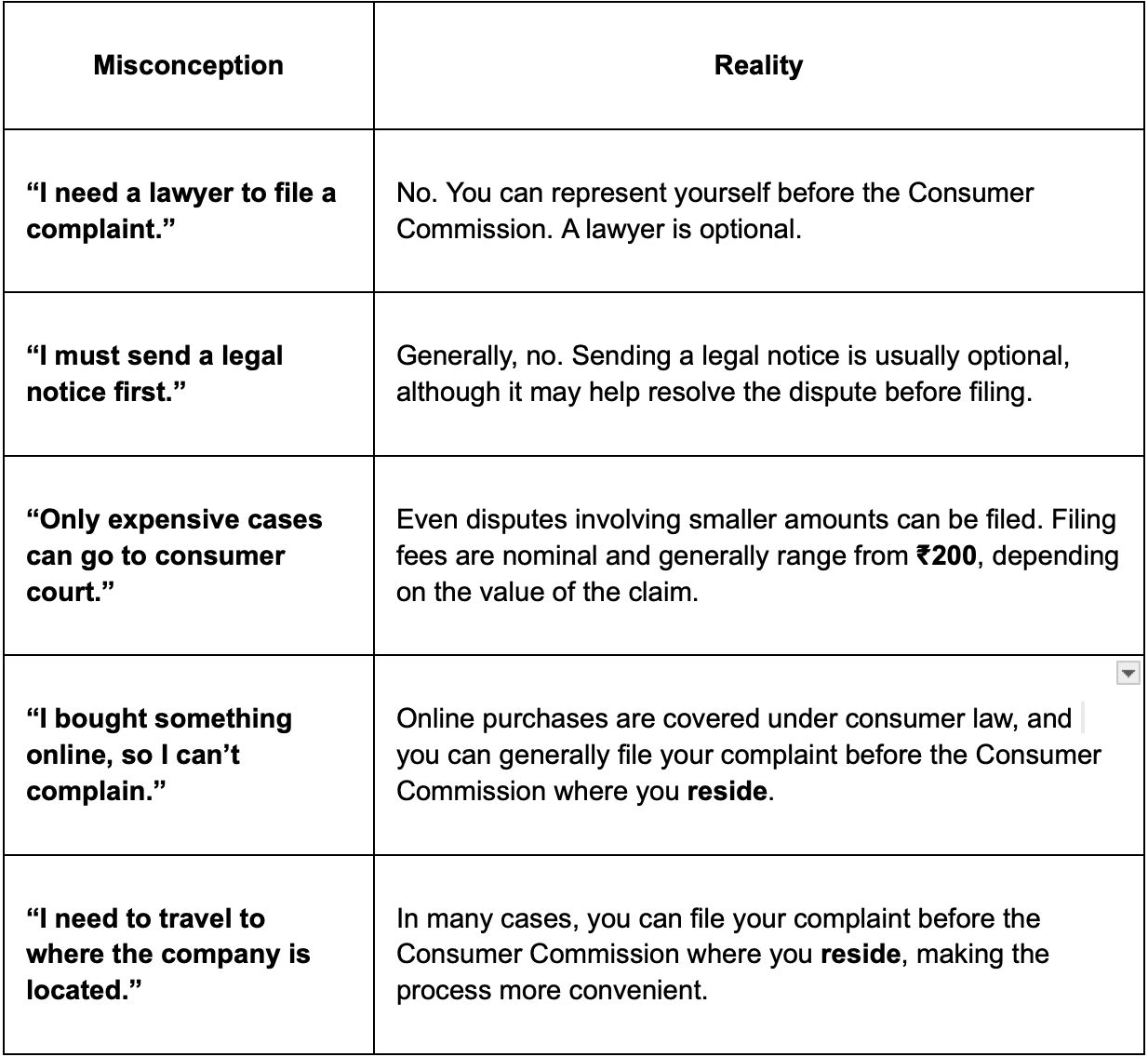
No. In most consumer disputes, sending a legal notice before filing a complaint is not a mandatory legal requirement.
However, many consumers and advocates choose to send one because it can be helpful. A legal notice may:
- Encourage the business to resolve the dispute without litigation.
- Clearly set out your grievance and the relief you are seeking.
- Create a dated record showing that you attempted to resolve the matter before approaching the Consumer Commission.
If you have already sent a legal notice, keep a copy along with proof of delivery, as it may support your case. If you haven’t sent one, you can generally proceed with filing your consumer complaint directly.
Which Consumer Commission Should You Approach?
Filing your complaint before the correct Consumer Commission is important. If a complaint is filed before the wrong forum, it may be returned or transferred, causing unnecessary delay.
Pecuniary Jurisdiction
Pecuniary jurisdiction refers to which Consumer Commission has the authority to hear your complaint based on the value of the goods or services you actually paid for. Under the Consumer Protection Act, 2019:
- District Consumer Disputes Redressal Commission: Value of goods or services paid does not exceed ₹50 lakh.
- State Consumer Disputes Redressal Commission: Value exceeds ₹50 lakh but does not exceed ₹2 crore.
- National Consumer Disputes Redressal Commission: Value exceeds ₹2 crore.
For example, if you paid ₹8 lakh for a product or service and later claim additional compensation for the loss or inconvenience caused, the Commission is determined by the ₹8 lakh actually paid, not by adding the compensation you are claiming.
This is different from the position under the earlier consumer law, where both the value of the goods or services and the compensation claimed were considered for deciding jurisdiction.
Territorial Jurisdiction
Territorial jurisdiction determines which Consumer Commission you should file your complaint before.
Under the Consumer Protection Act, 2019, you can generally file your complaint before the Consumer Commission within whose local limits:
- The opposite party (or any one of them, if there is more than one) resides, carries on business, has a branch office, or personally works for gain;
- The cause of action, wholly or partly, arose; or
- You, the complainant, reside.
One of the consumer-friendly features of the current law is that you can generally file the complaint where you reside, making it easier to pursue your case without having to travel to the seller’s location. This is particularly helpful in disputes involving online purchases, where the business may be located in another city or state.
Kerala has 14 District Consumer Disputes Redressal Commissions, one in each district. Higher-value complaints and appeals from District Commission orders are heard by the Kerala State Consumer Disputes Redressal Commission in Thiruvananthapuram.
Time Limit for Filing
In general, a consumer complaint should be filed within two years from the date on which the cause of action arises.
Because limitation periods are important, it is advisable to file your complaint as soon as possible after the dispute arises. Waiting too long may affect your ability to pursue the complaint, so avoid delaying once it becomes clear that the issue cannot be resolved directly with the business.
Documents You'll Need
A well-organised set of documents makes it much easier to present your case before the Consumer Commission. Depending on your complaint, you should keep copies of:
- Invoice, bill, or purchase receipt
- Warranty card or service agreement (if applicable)
- Emails and WhatsApp conversations with the business
- Screenshots of order confirmations, customer support chats, or app interactions
- Photographs or videos showing the defect or deficiency
- Bank statements or payment confirmations
- Complaint reference numbers generated by customer care
- Copy of the legal notice (if you sent one) and proof of delivery
- Any replies received from the business
- Identity and address proof, if required for filing
These documents help establish the facts of your complaint and support the relief you are seeking. Keeping your records organised from the beginning can make the filing process smoother and strengthen your case before the Consumer Commission.
How to File a Consumer Complaint Online
Consumers can file complaints online through the e-Jagriti portal, the official platform for filing consumer complaints before the District, State, and National Consumer Commissions.
If you haven’t yet approached the business or attempted an amicable resolution, you may also consider using the National Consumer Helpline (NCH) through its online portal or by calling 1915. The NCH helps facilitate communication between consumers and businesses and may help resolve certain disputes without formal proceedings.
If you need to file a complaint before a Consumer Commission, the general process is:
- Create an account. Register on the e-Jagriti portal using your mobile number and email address, then complete the OTP verification.
- Start a new complaint. Select the option to file a consumer complaint and choose the appropriate District, State, or National Consumer Commission based on the pecuniary and territorial jurisdiction rules discussed above.
- Enter the details of the parties. Provide your details as the complainant and the correct legal name and address of the business or service provider against whom you are filing the complaint.
- Prepare your complaint. Clearly explain what you purchased or the service you received, what went wrong, the steps you took to resolve the issue, and the relief you are seeking.
- Upload your supporting documents. Attach documents such as your invoices, receipts, emails, screenshots, photographs, payment records, identity and address proof, and any other evidence supporting your complaint. When uploading files, give them clear names (for example, Invoice.pdf or Payment_Receipt.pdf) so they are easy to identify.
- Pay the applicable filing fee. The portal allows online payment through the available payment options and generates an acknowledgement once the payment is successful.
- Submit and save your acknowledgement. After filing, note down or download your acknowledgement and complaint details for future reference. You can use the portal to track the progress of your complaint.
How to File Offline
If you prefer to file your complaint in person, you can do so before the Consumer Commission that has jurisdiction over your case.
The general process is:
- Prepare a written complaint containing your details, the details of the opposite party, the facts of the dispute, and the relief you are seeking.
- Attach supporting documents such as invoices, receipts, correspondence, photographs, payment records, and any other relevant evidence.
- Prepare the required affidavit verifying the facts stated in your complaint.
- Submit the complaint, supporting documents, affidavit, and the applicable filing fee at the Consumer Commission having jurisdiction over your case.
- Collect the acknowledgement or filing receipt and keep it safely for future reference.
Filing Fees
Consumer complaints are subject to filing fees, which vary depending on the value of the claim and the Consumer Commission before which the complaint is filed.
Under the current fee structure, filing fees generally range from ₹200 to ₹7,500. Before filing your complaint, it is advisable to check the latest fee schedule on the official e-Jagriti portal or with the relevant Consumer Commission, as the applicable fee depends on the value of your claim and the forum where the complaint is filed.
What Happens After Filing?
Once your complaint is filed, the process generally moves through these stages:
- Scrutiny and admission: The Consumer Commission checks whether your complaint is complete and whether it has the necessary jurisdiction to hear the matter.
- Notice to the opposite party: If the complaint is admitted, the Commission issues a notice to the business or service provider, giving them an opportunity to respond.
- Reply and evidence: Both parties submit their written statements and supporting documents. In many cases, evidence is presented through affidavits and documentary records.
- Mediation (where appropriate): If both parties agree, the dispute may be referred to mediation in an attempt to reach an amicable settlement.
- Hearings: If the matter is not settled, the Commission hears both sides before making a decision.
- Final order: After considering the evidence and submissions, the Commission passes its decision.
- Appeal: If either party is dissatisfied with the decision, they may have the right to appeal before the appropriate higher Consumer Commission, subject to the applicable legal provisions.
While the law aims to ensure consumer disputes are resolved as efficiently as possible, the actual time taken varies depending on the complexity of the case and the workload of the Consumer Commission. Some straightforward cases may be resolved in just a few months, while others can take longer.
Do You Need a Lawyer?
No. You can represent yourself before the Consumer Commission, and many consumers do exactly that. The process is intended to be accessible without requiring legal representation.
However, if your dispute involves complex legal issues, a high-value claim, or substantial evidence, consulting or engaging an advocate may be helpful.
What Relief Can the Consumer Commission Grant?
Depending on the facts of your case, the Consumer Commission may grant relief such as:
- Refund of the amount paid
- Replacement of a defective product
- Repair or removal of defects
- Compensation for the loss, inconvenience, or harassment suffered
- Directions requiring the business to take corrective action
- Discontinuation of unfair trade practices or misleading advertisements
- Other appropriate relief permitted under the Consumer Protection Act, 2019
Common Misconceptions
Key Takeaways
- You can file a consumer complaint for defective goods, deficient services, unfair trade practices, misleading advertisements, and other consumer disputes.
- The appropriate Consumer Commission depends on the value of the goods or services you paid for.
- You can generally file your complaint before the Consumer Commission where you reside, making it easier to pursue your claim.
- Consumer complaints should generally be filed within two years from the date the cause of action arises.
- You do not need a lawyer to file a consumer complaint.
- You can file your complaint online through the e-Jagriti portal or offline before the appropriate Consumer Commission.
- Keep all supporting documents, including invoices, payment records, emails, screenshots, photographs, and other evidence, as they are essential to your case.
How Court Click Can Help
Understanding your legal rights is only one part of navigating the legal system. If you’re involved in a court case, staying informed about hearing dates, orders, and case progress can become challenging.
Court Click helps litigants stay informed by bringing important court updates right to their phone. You can track hearing dates, receive notifications when orders or judgments are uploaded, view your case timeline, and apply for a Certified True Copy (CTC) of court orders or judgments directly through the app. It’s a simple way to stay updated once court proceedings begin.
Frequently Asked Questions
1. What is a consumer complaint?
A consumer complaint is a formal grievance filed before a Consumer Disputes Redressal Commission against a seller, manufacturer, service provider, or other business for issues such as defective goods, deficient services, unfair trade practices, or overcharging.
2. Who can file a consumer complaint?
A consumer complaint may be filed by the consumer, their legal heir or legal representative, a recognised consumer association, the Central or State Government, one or more consumers with the same interest, or a guardian acting on behalf of a minor.
3. Is a lawyer compulsory to file a consumer complaint?
No. You can represent yourself before the Consumer Commission. However, if your case is legally or factually complex, you may choose to seek legal assistance.
4. What is e-Daakhil, and is it still in use?
e-Daakhil was the original online portal for filing consumer complaints. The official system has now transitioned to e-Jagriti, and the older e-Daakhil portal now redirects users to the current online filing platform.
5. Can I file a consumer complaint online?
Yes. Consumer complaints can be filed online through the e-Jagriti portal, which supports filing before the District, State, and National Consumer Commissions.
6. Is sending a legal notice mandatory before filing?
No. In most consumer disputes, sending a legal notice is not mandatory. However, many consumers choose to send one because it may encourage an early settlement and creates a written record of the dispute.
7. How much does it cost to file a consumer complaint?
Filing fees are modest and generally range from ₹200 to ₹7,500, depending on the value of the claim and the Consumer Commission before which the complaint is filed.
8. How long does a consumer case take to resolve?
The time taken varies from case to case. While consumer disputes are intended to be resolved as efficiently as possible, the actual timeline depends on factors such as the complexity of the dispute and the workload of the Consumer Commission.
9. Can I claim compensation, not just a refund?
Yes. Depending on the facts of your case, the Consumer Commission may grant relief such as a refund, replacement, repair, compensation, or other appropriate corrective directions.
10. What if I file after the two-year limitation period?
Consumer complaints should generally be filed within two years from the date on which the cause of action arises. Missing this limitation period can affect your ability to pursue the complaint, so it is important to file within the prescribed time.
11. Can I file a complaint against a hospital?
Yes. Complaints relating to deficiency in medical services may be brought before the Consumer Commission, subject to the applicable provisions of consumer law.
12. Can I complain against an online shopping website?
Yes. Consumer protection law applies to online purchases as well. Depending on the applicable jurisdictional rules, you can generally file your complaint before the Consumer Commission where you reside.
13. Can I appeal if I’m not satisfied with the order?
Yes. If you are dissatisfied with the decision of a Consumer Commission, you may have the right to appeal before the appropriate higher Consumer Commission, subject to the applicable legal provisions.
14. Where in Kerala can I file my complaint?
You can file your complaint before the District Consumer Disputes Redressal Commission having jurisdiction over your case, online through e-Jagriti, or before the Kerala State Consumer Disputes Redressal Commission where applicable.
Disclaimer
This article is intended for general informational and educational purposes only and does not constitute legal advice. Consumer protection laws, procedures, fees, and jurisdictional rules may change over time. Before taking legal action, consult a qualified legal professional or refer to the latest information available through the official e-Jagriti portal and the Department of Consumer Affairs.