How to File for Divorce in Kerala: A Step-by-Step Guide
This guide explains how to file for divorce in Kerala step by step, including the process, required documents, court stages, and other important things you should know.
Mutual Divorce vs. Contested Divorce: What's the Difference?
Before anything else, it helps to understand which type of divorce applies to your situation. In Kerala, as in the rest of India, divorce proceedings broadly fall into two categories.
Mutual Consent Divorce
This is when both spouses agree to end the marriage. There's no dispute to resolve in court about whether the divorce should happen. Both parties file together, agree on key matters like custody or maintenance, and go through a structured court process.
Contested Divorce
This is when one spouse files without the other's agreement, or when both agree on divorce but cannot settle on terms like custody or property. The filing spouse must establish valid legal grounds, such as cruelty, desertion, adultery, or serious mental illness, and the court hears both sides before deciding.
Note: The governing law depends on your religion and how your marriage was registered, generally covered under the Hindu Marriage Act, 1955, Indian Divorce Act, 1869, Special Marriage Act, 1954. If you're unsure which law applies to you, an advocate can clarify this quickly in a first consultation.
Step-by-Step Divorce Filing Process in Kerala
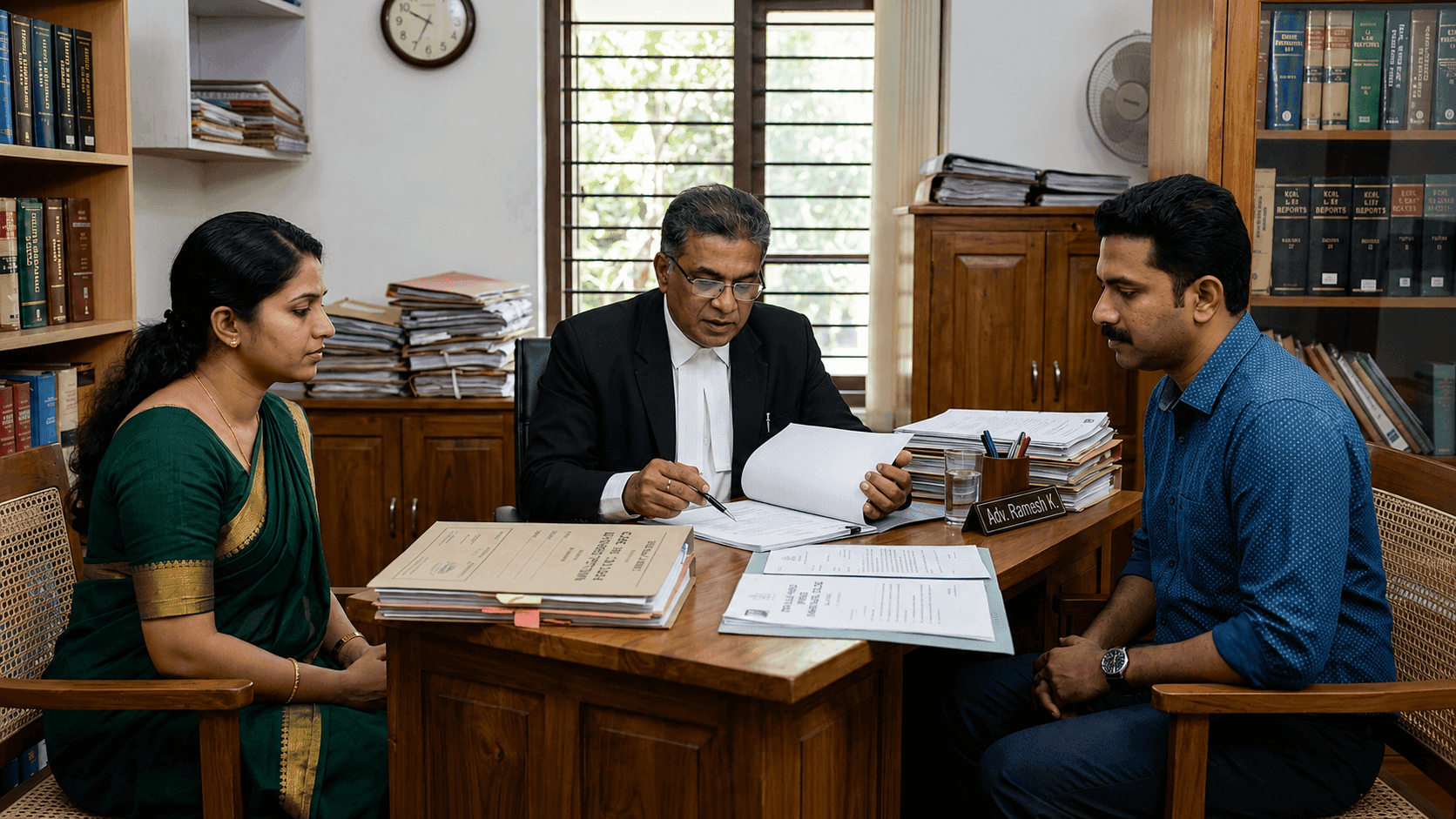
Step 1: Speak with an Advocate
A family law advocate will review your situation, tell you which type of divorce applies, help you understand what to expect, and identify any complications early.
Step 2: Gather Your Documents
Having the right documents ready before you approach the court makes the entire process considerably smoother. Here is a general checklist:
- Original marriage certificate or other acceptable proof of marriage
- Aadhaar card, passport, or other government-issued ID proof
- Proof of current residence (utility bills, rental agreement, etc.)
- Details of income and financial assets (especially relevant for maintenance/alimony claims)
- Passport-size photographs of both parties
- Evidence supporting the grounds claimed (if contested)
Your advocate will review this list based on your specific situation and confirm exactly what is required.
Step 3: Preparation and Filing of the Divorce Petition
Your advocate drafts the divorce petition, a formal document submitted to the Family Court. This petition explains the reason for divorce, the terms being sought (such as custody or maintenance), and the relevant facts of the marriage.
For mutual divorce: Both spouses sign and file together as a joint petition, including agreed-upon terms.
For contested divorce: One spouse (the petitioner) files. The petition clearly states the grounds for divorce and supporting facts.
Step 4: Court Accepts the Petition and Issues Notice
Once the petition is filed, the court processes it and issues a formal notice to the other spouse (the respondent), requiring them to appear or submit a response.
Where is the petition filed?
Divorce petitions in Kerala are handled by Family Courts. The petition is usually filed by the advocate before the Family Court in the district where:
- The marriage took place, or
- The couple last lived together, or
- The respondent currently resides.
Step 5: Hearings, Counselling, and the Cooling-Off Period
For mutual divorce: After both parties record their initial statements in what is called the First Motion, the court typically mandates a six-month cooling-off period, a waiting period meant to allow couples time to reconsider. Once this period has passed (and within 18 months of the First Motion), both parties appear again for the Second Motion to confirm they still want to proceed.
In certain genuine cases, courts have the discretion to waive this cooling-off period, though this is not automatic.
For contested divorce: The case moves through a series of hearings. Both sides present evidence, examine witnesses, and argue their positions. Some courts may also refer parties to mediation as part of the process, particularly when children are involved.
Step 6: Court Decision and Final Decree
After reviewing all submissions and verifying that all legal requirements are met, the court passes a Final Decree of Divorce, the official court order that dissolves the marriage.
Keep a certified copy of this decree. You might need it to update your marital status in official records like Aadhaar, passport, and employment documents.
Important Things People Worry About
Child Custody
When children are involved, their well-being is the court's primary consideration, not the preferences of either parent alone. Indian family courts look at several factors when deciding custody: the child's age, emotional bond with each parent, financial stability of each parent, and the child's own preferences (especially if they are older).
Custody can take different forms, one parent may have primary physical custody while the other has visitation rights, or both parents may share custody in a structured arrangement. In mutual divorces, custody terms are often agreed upon by both parents and submitted as part of the joint petition.
Maintenance and Alimony
Either spouse can seek financial maintenance. Courts consider both spouses' income, standard of living during the marriage, and the needs of any children when determining maintenance amounts. These can be arranged as a lump-sum settlement or as ongoing monthly payments.
Key Takeaways
- There are two main types of divorce in Kerala: mutual consent and contested. Mutual divorce is faster and less adversarial.
- Divorce petitions are filed at the appropriate Family Court in Kerala.
- The process typically involves consulting an advocate, preparing documents, filing the petition, attending hearings, and receiving the final decree.
- Mutual divorce generally takes 6 months to 1 year; contested divorce can take 2–3 years or longer.
- A six-month cooling-off period is part of the mutual divorce process but may be waived in some cases.
- Child custody decisions are always guided by the best interests of the child, not just parental preference.
- Having the right documents ready from the start significantly reduces delays.
Legal processes often become easier when you can stay informed throughout your case journey. Court Click helps people stay updated on important case developments and also makes it easier to apply for Certified True Copies (CTCs) online and have them delivered, when you need official court documents later.
Frequently Asked Questions
How long does divorce take in Kerala?
A mutual consent divorce typically takes anywhere from 6 months to about 1 year, depending on court scheduling and whether the cooling-off period is waived. A contested divorce can take 2 to 3 years or more, depending on the complexity of the case, the evidence involved, and the court's workload.
Can I file for divorce in Kerala without my spouse agreeing?
Yes. If your spouse does not agree to divorce, you can file a contested divorce petition by establishing valid legal grounds such as cruelty, desertion, adultery, or mental illness. The court will then hear both sides and make a decision.
What documents are required for divorce in Kerala?
The core documents include your marriage certificate, ID and address proof, passport-size photographs, and financial records. For contested cases, evidence supporting the grounds for divorce is also required. Children's birth certificates are needed if custody is involved.
Can I file for divorce online in Kerala?
The first steps, such as consulting an advocate and drafting the petition, can be initiated online or virtually. However, the formal filing of the petition and court appearances still require physical presence at the Family Court. Online portals may assist with some procedural steps; your advocate will advise on what applies in your district.
How much does divorce cost in Kerala?
The total cost varies significantly. It includes court filing fees, advocate fees, and any costs related to documentation or additional proceedings. Mutual divorces are generally less expensive than contested ones. For a clearer estimate, consult a local family law advocate.
Which court handles divorce in Kerala?
Family Courts in Kerala have jurisdiction over divorce cases. You can file in the Family Court of the district where the marriage took place, where both spouses last lived together, or where your spouse currently resides.
What are valid grounds for contested divorce in Kerala?
Common legal grounds include cruelty (physical or mental), desertion, adultery, conversion to another religion, and certain mental disorders. The specific grounds and their requirements vary slightly depending on the law applicable to your marriage.
Who gets child custody after divorce in Kerala?
There is no automatic rule about who gets custody. Courts evaluate the circumstances of both parents and prioritise the welfare of the child above everything else. Custody arrangements can be sole, joint, or shared, and visitation rights are typically preserved for the non-custodial parent.
Can I claim maintenance or alimony in Kerala?
Yes. Either spouse can seek maintenance. Courts consider both parties' income, the standard of living maintained during the marriage, and the financial needs of children. Maintenance can be awarded as a lump-sum amount or as recurring monthly payments.
What happens after the divorce decree is issued?
Once the Final Decree of Divorce is granted, you should update your marital status in official records such as your Aadhaar, passport, and any employer records. Certified copies of the decree will be required for this. Your advocate can guide you through post-decree formalities.
Can a divorce case filed in Kerala proceed if one spouse lives abroad?
Yes. If you are residing abroad, you can still have a divorce case filed in Kerala through a legally authorized representative. Your advocate will guide you on the necessary power-of-attorney documentation and process.
Disclaimer
This article is intended for general informational purposes only and does not constitute legal advice. Divorce laws and procedures can vary based on personal circumstances, the applicable personal law, and the specific Family Court. Always consult a qualified advocate for advice specific to your situation.