
Who Is a Petitioner and Respondent in India? Meaning, Difference & Examples
Quick Answer
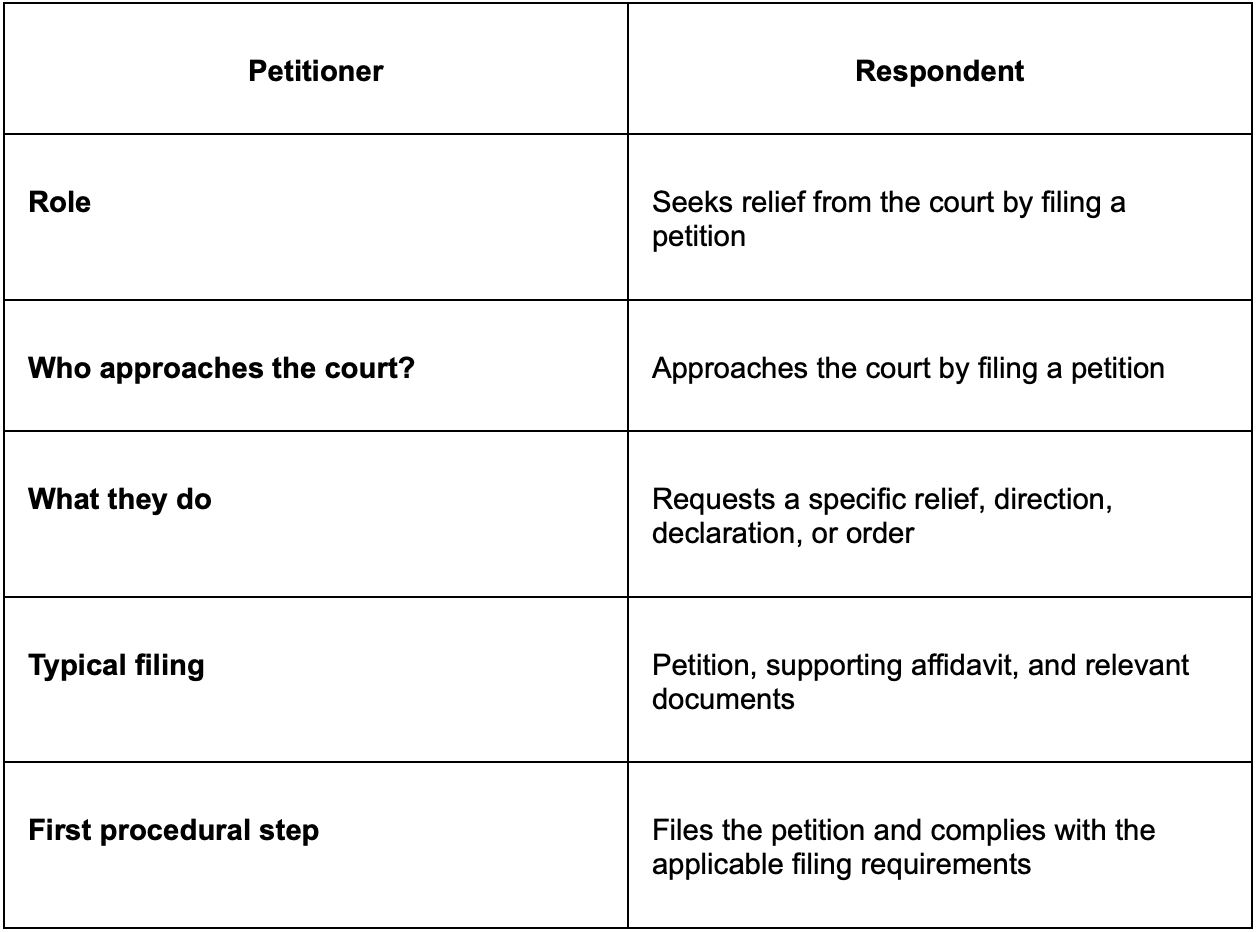
A petitioner is a person, organisation, company, or government authority that approaches a court or tribunal by filing a petition seeking a specific relief, direction, declaration, or order. A respondent is the person, organisation, company, or authority named in that petition who is required to respond to it.
Being named as a respondent does not mean you have done anything wrong. It simply means the petition concerns you, or that the court considers your response necessary before deciding the matter.
These exact terms, however, are not used in every legal proceeding. Indian courts use different names depending on the type of case. For example, an ordinary civil suit has a plaintiff and defendant, a consumer dispute has a complainant and opposite party, and an ordinary criminal prosecution is typically between the State (or prosecution) and the accused.
If you’ve received a court notice, are reading a court order, or are checking your case online, this guide will help you understand who you are in a case and why the terminology can change depending on the type and stage of the proceeding.
What Is a Petitioner?
A petitioner is a person or legal entity that files a petition, a formal written request asking a court or tribunal to grant a specific relief, direction, declaration, or order.
A petition is simply a formal request made to a court or tribunal asking it to grant a particular legal relief. Not everyone who starts a legal case is called a petitioner. The title depends on the type of proceeding and the law under which the case is filed.
The term petitioner is commonly used in proceedings such as:
- Writ petitions
- Family and matrimonial matters
- Applications or petitions seeking bail
- Review petitions
- Revision petitions
- Petitions for Special Leave to Appeal (commonly called Special Leave Petitions or SLPs)
- Certain proceedings before tribunals, High Courts, and the Supreme Court
A petitioner can be:
- An individual citizen
- A company or registered organisation
- An association or society
- A government department or public authority
- More than one person filing jointly
What a petitioner seeks depends entirely on the type of proceeding. For example:
- In a writ petition, a person may ask the High Court or the Supreme Court to protect a legal or constitutional right or direct a public authority to perform a legal duty.
- In a divorce petition, a spouse asks the Family Court to dissolve the marriage or grant another matrimonial relief.
- In an application or petition seeking bail, a person requests the court to grant bail in accordance with the applicable law.
Example: If you file a writ petition before the Kerala High Court asking it to direct a government department to release your pending pension, you are the petitioner, and the government department is one of the respondents.
What Is a Respondent?
A respondent is the person, organisation, company, or authority that is required to answer a petition filed before a court or tribunal.
They are usually served with notice of the proceedings and given an opportunity to respond. Depending on the type of case, they may file a counter-affidavit, objections, or another response permitted under the applicable law.
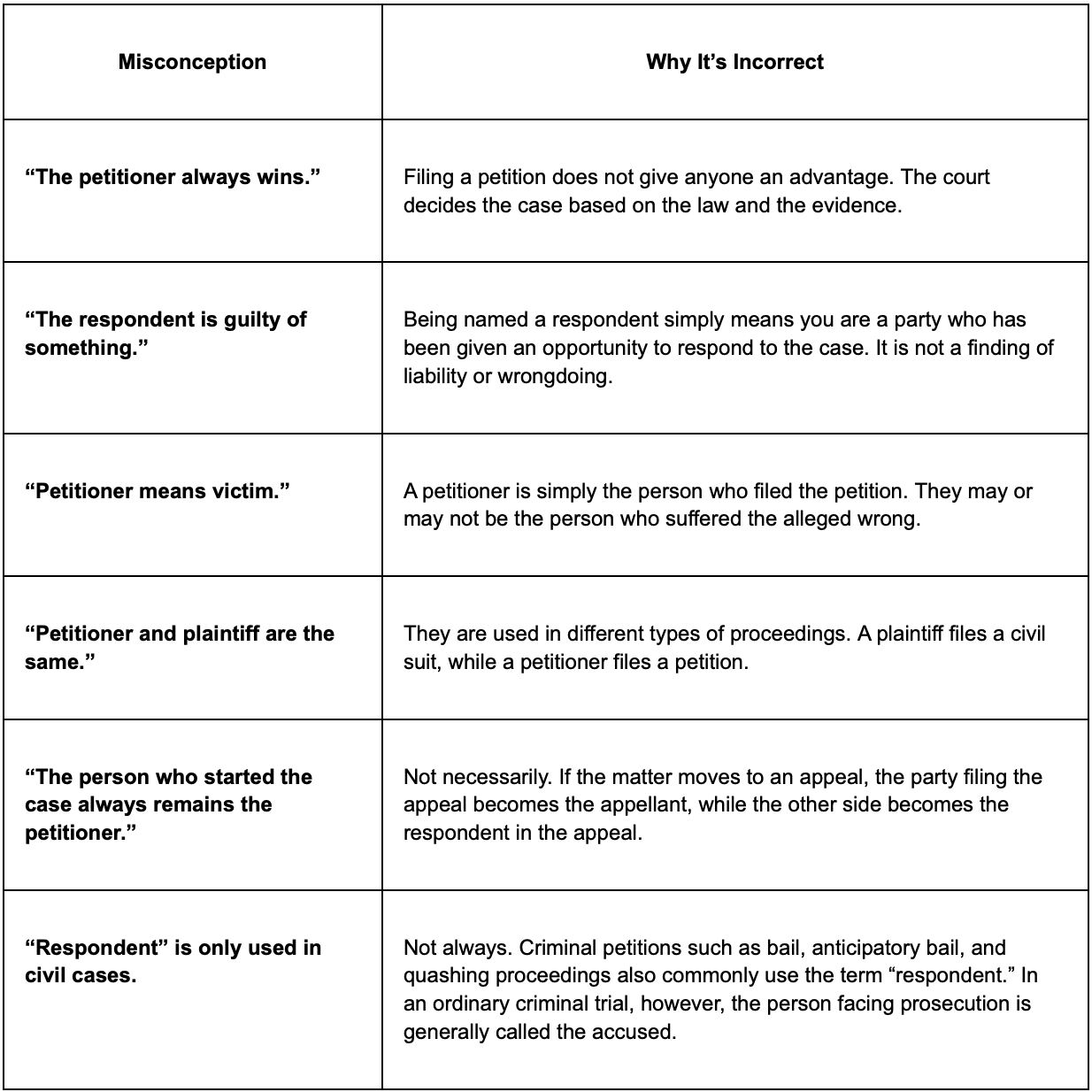
Important: Being named as a respondent does not mean the court has found you liable or accepted the petitioner’s claims. It simply means the petitioner is seeking relief that involves you, or that the court considers your response necessary before making a decision. The respondent is given an opportunity to present their side before the court reaches a conclusion.
A respondent could be:
- A government department responding to a writ petition
- A spouse responding to a divorce petition
- A company responding to a legal challenge
- Any individual, organisation, or authority whose rights or interests may be affected by the relief sought by the petitioner
The court hears both sides before deciding the case, and whether the petitioner succeeds depends on the facts, the applicable law, and the evidence presented.
Petitioner vs Respondent: Quick Comparison
Are Parties Always Called Petitioner and Respondent?
No. The terms used depend entirely on the type of legal proceeding and the law governing it. This is one of the most common reasons people get confused when checking their case online, because the same person may be described by different titles depending on the type of case or the stage of the proceedings.
Civil Suits - Plaintiff and Defendant
Ordinary civil disputes, such as property disputes, recovery of money, breach of contract, injunctions, and similar matters, are generally governed by the Code of Civil Procedure, 1908 (CPC).
A civil suit begins with the filing of a plaint, and:
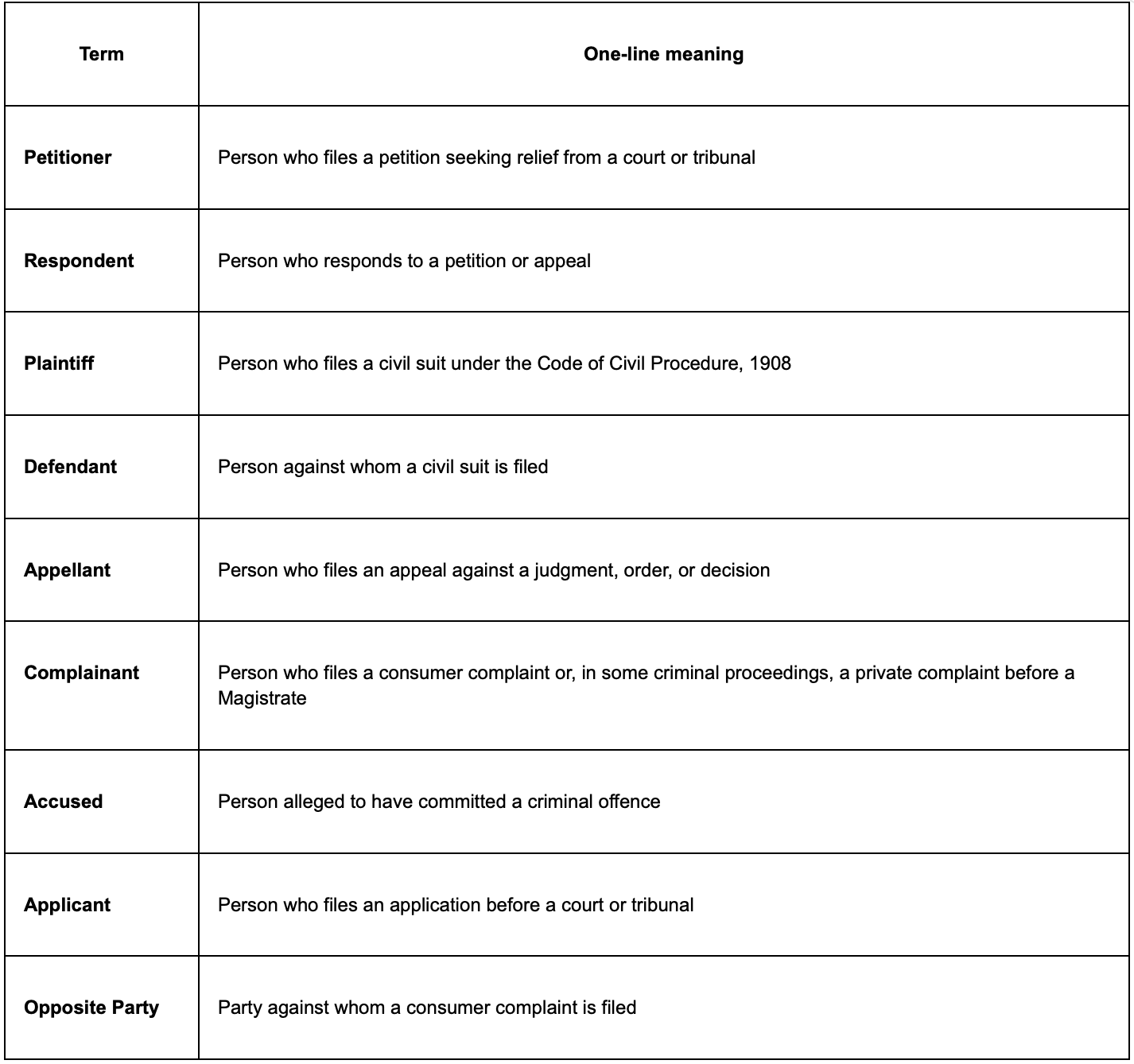
- The person filing the suit is called the plaintiff.
- The person against whom the suit is filed is called the defendant.
At the original stage of a civil suit, the parties are generally not referred to as the petitioner and respondent.
Example: If Anita files a civil suit seeking recovery of money from Rahul, Anita is the plaintiff, and Rahul is the defendant.
Writ Petitions - Petitioner and Respondent
A writ petition is generally filed before a High Court under Article 226 of the Constitution or before the Supreme Court under Article 32 to seek relief relating to legal or fundamental rights.
In these proceedings:
- The person approaching the court is the petitioner.
- The government department, public authority, or other party required to answer the petition is the respondent.
A writ petition generally sets out the facts of the case, the legal or constitutional right involved, and the relief sought from the court.
Example: If a student files a writ petition challenging the cancellation of admission by a public university, the student is the petitioner, while the university and the relevant authorities are the respondents.
Family and Matrimonial Cases - Petitioner and Respondent
Many proceedings before Family Courts are also filed as petitions.
For example, under the Hindu Marriage Act, 1955, proceedings relating to divorce, judicial separation, restitution of conjugal rights, and certain other matrimonial reliefs are presented as petitions.
In these cases:
- The spouse filing the petition is the petitioner.
- The other spouse is the respondent.
In a mutual consent divorce, both spouses jointly present the petition and are generally described as petitioners.
Consumer Complaints - Complainant and Opposite Party
Consumer disputes use different terminology.
Under the Consumer Protection Act, 2019:
- The person filing the complaint is called the complainant.
- The business, trader, manufacturer, service provider, insurer, builder, or other party against whom the complaint is filed is called the opposite party.
These proceedings generally do not use the terms petitioner and respondent.
Criminal Cases - State, Complainant, and Accused
Criminal proceedings follow different terminology because criminal offences are generally treated as offences against the State.
In an ordinary criminal prosecution:
- The prosecution is usually conducted by the State through a Public Prosecutor.
- The person alleged to have committed the offence is the accused.
- Depending on how the criminal case was initiated, there may also be a complainant, informant, or victim who plays a role in the proceedings.
However, the terms petitioner and respondent can still appear in criminal proceedings when someone files a petition or application before a higher court.
For example, proceedings relating to:
- Bail
- Anticipatory bail
- Quashing of criminal proceedings
- Criminal revisions
may describe the person approaching the court as the petitioner, while the State is commonly shown as the respondent. Depending on the nature of the case, other affected parties may also be made respondents.
What Happens During an Appeal?
An appeal is filed when a party asks a higher court to review the decision of a lower court or tribunal. At this stage, the terminology changes again.
The person filing the appeal is called the appellant, regardless of what they were called in the earlier proceeding. The party responding to the appeal is called the respondent.
This is one of the most common reasons people get confused when checking their case online, because the same person can have different titles at different stages of the same dispute.
For example:
- If you were the defendant in a civil suit, lost the case, and then filed an appeal, you become the appellant, while the original plaintiff becomes the respondent in the appeal.
- If you were the petitioner in a writ petition and later filed an appeal where the law permits, you become the appellant, while the original respondent continues as the respondent in the appeal.
- Likewise, if the original respondent challenges the court’s decision, they become the appellant, and the original petitioner becomes the respondent.
The key takeaway: The same person may be described as a petitioner, plaintiff, defendant, appellant, or respondent at different stages of the same legal dispute. The title depends on the current proceeding, not on who originally started the dispute.
Is a Petitioner the Same as an Appellant?
No. Although the same person may hold both roles at different stages of a case, the two terms have different meanings.
A petitioner is a person who files a petition seeking relief from a court or tribunal.
An appellant is a person who files an appeal, asking a higher court to review a judgment, order, or decision made by a lower court or tribunal.
For example, a person who files a writ petition before a High Court is a petitioner. If that person later files an appeal where the law permits, they become the appellant in the appellate proceedings.
The title depends on the type of proceeding before the court, so the terms petitioner and appellant should not be used interchangeably.
How to Identify the Petitioner and Respondent in a Court Case
Here’s how you can identify the parties correctly.
Look at the cause title
The cause title appears on the first page of a petition, order, judgment, or other court document. It usually lists the parties in a format such as A vs. B.
Check the labels next to each name
Court records generally identify each party by their role, such as:
- Petitioner
- Respondent
- Plaintiff
- Defendant
- Appellant
- Complainant
- Opposite Party
These labels tell you the party’s role in that particular proceeding.
Check the case type
The case type often indicates the nature of the proceeding.
For example:
- WP(C) - Writ Petition (Civil)
- OP - Original Petition (commonly used in certain Family Court proceedings and some other original proceedings)
- Crl.M.C. - Criminal Miscellaneous Case
Different courts may use different abbreviations, so always read the case type together with the party labels.
Check the advocate details
Court records often list the advocates appearing for each party. This can help you identify your role if several parties have similar names or if multiple parties are involved.
Important: Never assume that the first person named in the case title originally started the dispute. The case you are viewing could be an appeal, review, revision, or another later proceeding, where the party names and designations may have changed.
What Do "Petitioners" and "Respondents" (Plural) Mean?
Many court cases involve more than one person on either side. In such cases, the court identifies each party by assigning a number.
For example:
- Petitioner No. 1 or P1
- Petitioner No. 2 or P2
- Petitioner No. 3 or P3
or
- Respondent No. 1 or R1
- Respondent No. 2 or R2
- Respondent No. 3 or R3
These numbers simply distinguish the different parties. They do not indicate who is more important or more responsible.
You may also see the abbreviation ”& Ors.”, which stands for “and Others.” It means there are additional parties on that side of the case whose names have been shortened in the case title but are listed in full in the court records.
Example: Suppose three siblings jointly file a petition against their uncle and two companies. The case title might appear as:
Rajan & Ors. v. ABC Developers & Ors.
Here:
- Rajan is Petitioner No. 1.
- His siblings are Petitioner No. 2 and Petitioner No. 3.
- The company and the other parties are listed as Respondent No. 1, Respondent No. 2, and so on.
Numbering the parties simply helps the court identify each person or organisation clearly throughout the proceedings.
Petitioner vs Plaintiff vs Appellant vs Complainant: Full Comparison
Common Misconceptions
Key Takeaways
- Petitioners and Respondents: Your explanation matches the sources perfectly. These terms are indeed the standard designations for Writ Petitions (filed under Articles 32 and 226 of the Constitution), appeals, matrimonial and family matters, and criminal applications such as quashing proceedings or bail.
- Civil, Consumer, and Criminal Roles: The terminology is correct. Civil cases use plaintiff and defendant. In criminal trials, the case is prosecuted by the State against the accused. While the handbook references "complainants" in criminal matters and "opposite parties" across applications, note that the specific lower-court consumer court designations (complainant and opposite party) are not explicitly detailed in these handbook excerpts, though they are completely accurate in Indian practice.
- Implication of Guilt: This is highly accurate. Being a defendant or respondent carries no assumption of wrongdoing. In civil suits, the burden of proof rests entirely on the plaintiff who filed the case.
- Shifting Roles on Appeal: Grounded perfectly. An appellant is any party (plaintiff or defendant) who appeals a lower court’s decision to a higher court. The opposing party automatically becomes the respondent.
- Numbered Parties and "& Ors.": Your explanation of "Petitioner No. 1," "Respondent No. 2," etc., is legally precise. The Supreme Court handbook explicitly calls this the "serial number in the array of parties" and rules that a party's original serial number is never altered during the case. The use of "and Others" (abbreviated as "& Ors." in case titles) is also well-documented in major cases.
- Reading Court Records: Highly accurate. The handbook mandates that the cause title must clearly state the status of the parties in both the lower courts and the current appellate/petition stage, and that the official class/type of case must be listed alongside these party labels.
How Court Click Can Help
Once you're involved in a court case, understanding your role is only one part of staying informed. Court Click helps litigants track their case, know hearing dates, view case timelines, receive updates on court orders and judgments, and apply for Certified True Copies (CTCs) of orders and judgments directly through the app, so you're not left confused not knowing what's happening in your own case.
Frequently Asked Questions
1. Who is a petitioner? A petitioner is the person or entity who files a petition before a court, asking for a specific relief, order, or direction.
2. Who is a respondent? A respondent is the party named in a petition who is given a chance to respond to the claims made against them.
3. Can there be more than one petitioner? Yes. Multiple people can jointly file a petition, and they are listed as Petitioner No.1, Petitioner No.2, and so on.
4. Can there be more than one respondent? Yes. A case can have several respondents, each numbered, Respondent No.1, Respondent No.2, and so on.
5. Can a company be a petitioner? Yes. Companies, associations, and other registered entities can file petitions, typically through an authorised representative.
6. Can the government be a petitioner? Yes. Government departments and public authorities can be petitioners in certain proceedings, just as they can be respondents.
7. Is respondent the same as accused? No. "Accused" is used specifically in criminal cases for the person alleged to have committed an offence. "Respondent" is a civil-law and writ-petition term.
8. Can a petitioner become a respondent? Yes. If the case is appealed and the original petitioner wins, they typically remain the respondent in the appeal filed by the other side.
9. What is Respondent No.1? When a case has multiple respondents, they're numbered in the order added to the case, and "Respondent No.1" refers to the first-listed respondent.
10. Is petitioner the same as plaintiff? No. A plaintiff files a civil suit under the Code of Civil Procedure; a petitioner files a petition, such as a writ petition or a divorce petition, under a different procedural framework.
11. Is petitioner the same as appellant? No. A petitioner files a fresh petition seeking relief; an appellant challenges a decision already made in an earlier proceeding.
13. Does being named a respondent mean I'm guilty? No. It only means the case involves you and the court wants to hear your side before making a decision.
14. Who files a writ petition? Anyone whose fundamental or legal rights have allegedly been violated, typically by a government authority, can file a writ petition as the petitioner.
15. Who files a divorce petition? Either spouse can file a divorce petition individually as the petitioner (with the other spouse as respondent), or both spouses can file jointly as petitioners in a mutual consent divorce.
Disclaimer: This article is for general informational purposes only and does not constitute legal advice. Court procedures and terminology can vary depending on the specific law, court, and facts of a case. For advice on your specific situation, please consult a qualified advocate.