
What Is an Ex Parte Order?
Quick Answer
An ex parte order is a court order passed after hearing only one side of a dispute. This may happen because the other party did not appear despite receiving notice, or because the court considered it necessary to pass an urgent temporary order before hearing the other side. Depending on the stage of the case, it may be a temporary measure, a procedural step within an ongoing proceeding, or part of a final decision. Indian law generally provides remedies for the absent party, which may include applying to set aside the order, filing an appeal, or, in certain family and maintenance matters, seeking a recall of the order. Acting quickly is important, as these remedies are usually subject to time limits.
What Does "Ex Parte" Mean?
The term “ex parte” comes from Latin and is commonly understood to mean “from one side” or “on behalf of one party.” In legal proceedings, it refers to a hearing, order, or decision made after hearing only one side of the dispute, without the participation of the other party at that stage.
“Ex parte” does not refer to a specific type of document. Instead, it describes the manner in which a court order or decision was made. An order may be passed ex parte at the beginning of a case, during the proceedings, or even at the stage of the final decision. The legal effect of an ex parte order depends on the nature of the case and the stage at which it was passed.
Why Do Courts Pass Ex Parte Orders?
Courts do not pass ex parte orders simply to penalise a party for being absent. Legal proceedings cannot remain indefinitely stalled, and courts are expected to move cases forward while ensuring fairness to both sides.
An ex parte order may be passed in situations such as:
- A party fails to appear on the hearing date despite the court being satisfied that proper notice or summons has been served.
- A party ignores the summons or does not respond to the proceedings.
- There is repeated and unexplained absence over multiple hearing dates.
- The court considers it necessary to pass an urgent temporary order before hearing the other side, such as in certain injunction matters where giving advance notice could defeat the purpose of the order.
In cases based on non-appearance, courts generally proceed ex parte only after being satisfied that notice or summons has been properly served. In urgent situations, however, courts may grant temporary ex parte relief before hearing the other side if waiting would defeat the purpose of the order.
Courts also recognise that there may be genuine reasons for a party’s absence. If an ex parte order or decree is later challenged, the absent party may be required to show sufficient cause for not appearing, such as lack of proper service, illness, a bona fide mistake regarding the hearing date, or other circumstances beyond their control.
In What Types of Cases Can Ex Parte Orders Be Passed?
Ex parte orders are not limited to one type of dispute. They can arise in a wide range of legal proceedings where one party does not appear or where the court considers immediate action necessary.
Common examples include:
- Civil suits of various kinds, governed by the Code of Civil Procedure, 1908 (CPC), including money recovery, contract, and property disputes.
- Family court matters, including divorce, judicial separation, child custody, visitation, and other matrimonial proceedings.
- Maintenance proceedings, where a court may proceed in the absence of a party who has been duly notified but fails to appear.
- Child custody and guardianship matters, where courts may pass interim or ex parte orders when circumstances require immediate attention.
- Consumer disputes, where Consumer Commissions may proceed ex parte if the opposite party fails to respond or appear within the prescribed time.
- Property disputes, where courts may grant urgent interim relief, such as injunctions, to prevent immediate harm before the other side is heard.
The exact procedure and remedies can vary depending on the type of case and the law governing it.
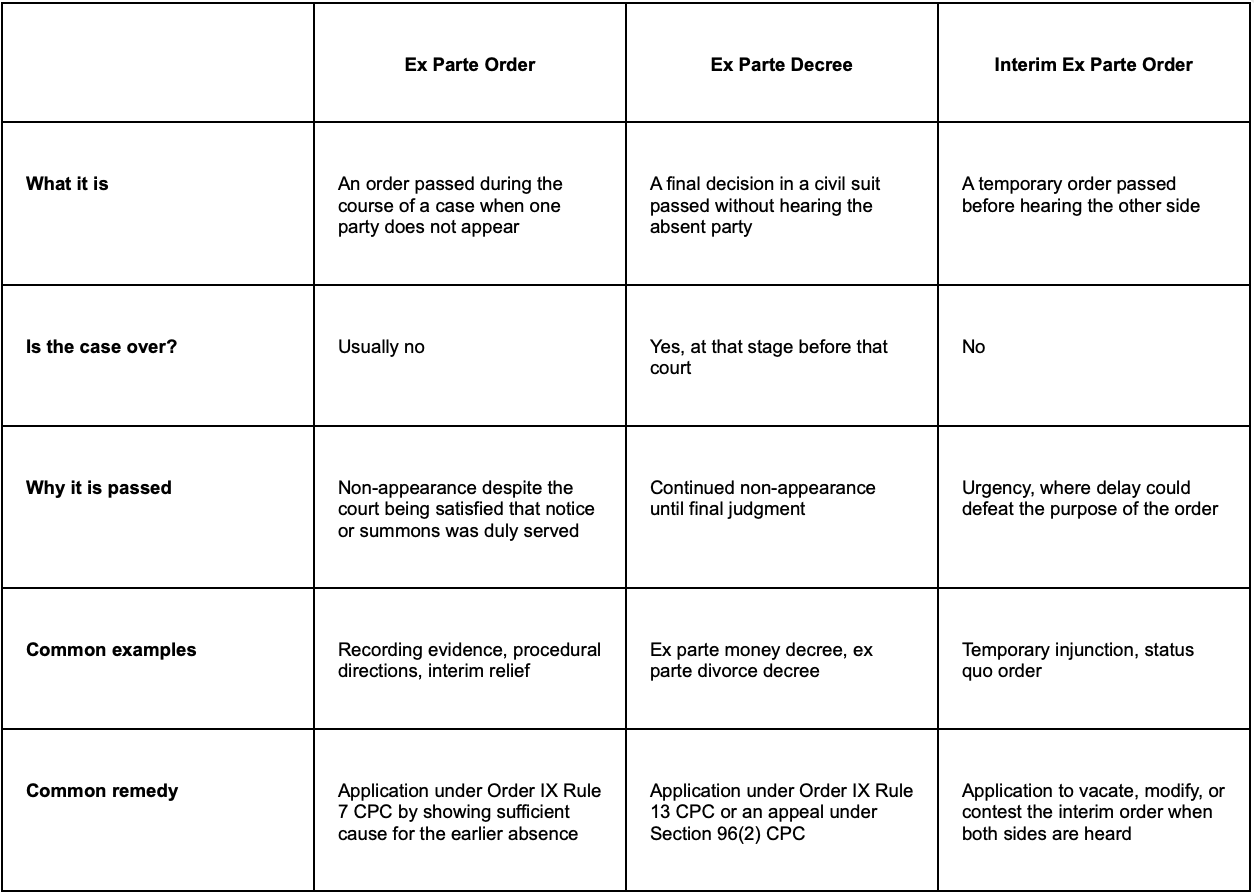
Ex Parte Order vs Ex Parte Decree vs Interim Ex Parte Order
These three terms get used loosely, but they don't mean the same thing, and the difference changes what you should do next.
Does an Ex Parte Order Mean You Lost the Case?
Not necessarily, and this is the part most people misunderstand. An interim ex parte order, like a short-term injunction, isn't a verdict on the dispute; it's a temporary arrangement, and you're entitled to be heard before the matter is decided properly. An ex parte order passed during an ongoing suit also doesn't mean the case is over: the court may have started recording the other side's evidence, but you can still apply to be let back in before a final decree is passed.
Where things are genuinely final is an ex parte decree, the court's concluding judgment in the suit. It carries legal weight and can be enforced, but it isn't the end of the road. Indian law provides clear, time-bound ways to ask the court to reconsider.
What Happens After an Ex Parte Order Is Passed?
If you've been set ex parte during a suit, the court typically records the other party's evidence without you, and the case keeps moving toward a decree. If a final decree has already been passed, it's binding and can be acted upon, for example to obtain maintenance, finalise a divorce, or recover money, unless and until it is set aside; the other party may also begin execution proceedings.
Either way, get a copy of the order quickly, understand what stage your case is at, and find out your window of time to respond. Delay is the single biggest reason these situations become harder to fix.
Can an Ex Parte Order Be Challenged?
Yes. In many cases, an ex parte order or decree can be challenged. Indian law provides remedies because courts recognise that decisions made in a party’s absence may sometimes need to be reconsidered.
The appropriate remedy depends on the type of case, the stage of the proceedings, and the nature of the order that was passed.
In civil cases, a party who was absent may be able to ask the same court to set aside the ex parte proceedings or the ex parte decree by showing that the summons was not properly served or that there was sufficient cause for the non-appearance. Examples of sufficient cause may include illness, a genuine mistake regarding the hearing date, or other circumstances beyond the party’s control.
In some situations, the affected party may also have the right to file an appeal before a higher court. Family court matters, maintenance proceedings, consumer disputes, and other proceedings may have their own specific procedures and remedies.
The most important thing is to act quickly. Many remedies are subject to strict time limits, and unnecessary delay can make it more difficult to obtain relief.
An ex parte order is therefore not always the end of the matter. However, whether it can be challenged, and the correct procedure for doing so, depends on the facts of each case and the law governing that particular proceeding.
What Should You Do If an Ex Parte Order Is Passed Against You?
- Get a certified copy of the order immediately. You need the exact order, not just a description, to know what was decided and when.
- Read it carefully, or have someone explain it, so you understand whether it's interim, mid-case, or a final decree.
- Note the date and act quickly. Most remedies have a strict deadline. The sooner you understand your position, the easier it will be to take any necessary steps.
- Gather proof of why you missed the hearing, such as medical records, travel documents, or proof you weren't properly served.
- Speak to a qualified advocate as soon as possible to confirm the right remedy and file it within the deadline.
Stay Updated on Your Case
Many ex parte orders happen because a party misses a hearing date, does not realise a new order has been uploaded, or is unaware of developments in the case.
If you have a case before the Kerala High Court or District Courts in Kerala, Court Click can help you stay informed by sending updates directly to your phone. Users can track hearing dates, case status changes, orders, and judgments from a single place, reducing the risk of missing important developments in their case.
Court Click also allows litigants to apply for a Certified True Copy (CTC) directly through the app. If an ex parte order or decree has been passed and you need the official court-certified copy, you can request the CTC through Court Click and have it delivered to your doorstep or receive it as an eCopy, where available.
Frequently Asked Questions
What is an ex parte order? An order passed after hearing only one side, usually because the other party didn't appear despite proper notice.
What does ex parte mean in court? "Ex parte" is Latin for "from one side." It describes any hearing where only one party's case was presented to the judge.
Does ex parte mean I lost? Not necessarily; it depends on the stage. Interim and mid-case ex parte orders aren't final, while an ex parte decree is, though it can still be challenged.
Can an ex parte order be cancelled? Yes, if it was passed during a pending suit, by applying under Order IX Rule 7 CPC and showing good cause for your absence.
What is an ex parte decree? The final judgment in a civil suit, passed without hearing the defendant because they didn't appear after being properly served.
What should I do if I miss a hearing? Get a certified copy of the order, check your deadline to respond, and consult an advocate without delay.
Can I challenge an ex parte judgment? Yes, typically through an application under Order IX Rule 13 CPC, or an appeal under Section 96(2) CPC.
Can family courts pass ex parte orders? Yes. Family Courts follow CPC procedure for non-appearance, so an ex parte divorce, custody, or maintenance order is possible.
Can consumer courts pass ex parte orders? Yes, under Section 38(3) of the Consumer Protection Act, 2019, if the opposite party fails to respond in time.
How do I get a copy of the order? Apply for a certified copy from the court that passed it, or check the relevant eCourts or court portal for your case.
How can I track future case updates? Court Click notifies you of new hearing dates, orders, or judgments, so you don't have to keep checking manually.
Disclaimer
This article is for general educational purposes only and does not constitute legal advice. Laws and procedures relating to ex parte orders can vary depending on the type of case, the court involved, and the specific facts of each matter. Litigants are strongly advised to consult a qualified advocate to understand the remedies and deadlines that apply to their particular situation.