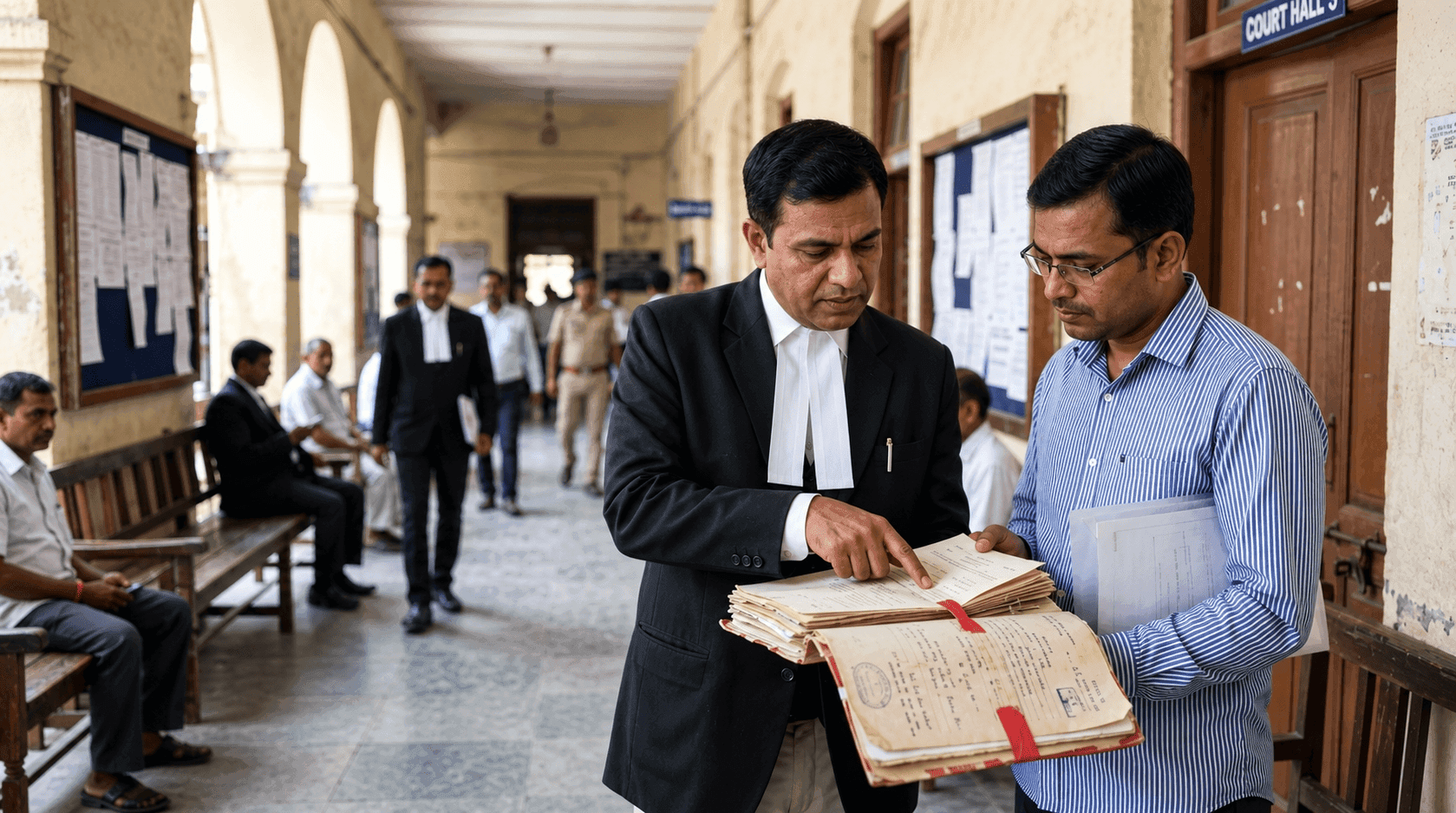
With case pendency in India crossing the 5.53 crore mark in 2026, accessing timely and clear case information has become a challenge for many litigants. For the average citizen, the distance between filing a petition and receiving a judgment is often filled with a fog of legal jargon and missed hearing dates.
Behind every case file is a person dealing with anxiety and the heavy emotional toll of waiting. This guide serves as your roadmap, breaking down the system's structure and showing you how to take control of your legal journey.
The Blueprint: How Indian Courts are Structured
The entire legal framework of the country is built upon the Constitution of India, which is the supreme law of the land. The Constitution establishes a clear separation of powers between three branches. These are the legislature that makes laws, the executive that implements them, and the judiciary that interprets them.
The Constitution guarantees a single, integrated, and independent judicial system. This means that unlike some countries where states have completely separate legal systems, the Indian judiciary acts as one unified structure from the lowest courts up to the highest. It is designed to be completely independent from the government, ensuring fair and impartial justice for all citizens without any outside political pressure.
To navigate your case successfully, it helps to understand exactly where it is being heard. Here is a comprehensive look at all the courts in India, From the highest court to the lowest courts.
The Hierarchy of Courts in India
1. The Supreme Court of India Located in New Delhi, the Supreme Court of India is the highest judicial authority in the country. It is the final court of appeal and the ultimate interpreter of the Constitution. Its decisions are binding on all other courts and tribunals across the nation.
2. The High Courts of India At the state level, the High Court is the highest legal authority. High Courts hear appeals from lower courts and possess special powers to protect the fundamental rights of citizens. here is the complete list of all 25 High Courts in India:
- Allahabad High Court
- Andhra Pradesh High Court
- Bombay High Court
- Calcutta High Court
- Chhattisgarh High Court
- Delhi High Court
- Gauhati High Court
- Gujarat High Court
- Himachal Pradesh High Court
- High Court of Jammu and Kashmir and Ladakh
- Jharkhand High Court
- Karnataka High Court
- Kerala High Court
- Madhya Pradesh High Court
- Madras High Court
- Manipur High Court
- Meghalaya High Court
- Orissa High Court
- Patna High Court
- Punjab and Haryana High Court
- Rajasthan High Court
- Sikkim High Court
- Telangana High Court
- Tripura High Court
- Uttarakhand High Court
3. District Courts and Sessions Courts Below the High Courts are the district level courts. When a judge listens to civil matters like property disputes, contracts, or family issues, they preside over the District Court. When the exact same judge listens to criminal matters like theft or assault, they preside over the Sessions Court.
4. Subordinate Courts This foundational level includes Munsiff Courts for minor civil disputes and Judicial Magistrate Courts for criminal offenses.
5. Specialised Bodies and Alternative Forums A complete understanding of the system also includes bodies that handle specific types of disputes:
6.Tribunals: Quasi-judicial bodies established to deal with specialized technical matters, such as environmental or business-related disputes.
7.Gram Nyayalayas: Village-level mobile courts established for providing quick and affordable justice at the doorsteps of rural citizens.
8.Lok Adalats: “People’s Courts” that focus on amicable settlement of cases through conciliation, helping reduce litigation time and costs.
You can view the complete list of all courts in India here: https://www.courtclick.com/blog/complete-list-of-all-courts-in-india-state-district-wise-court-directory
The Journey: Your Case Lifecycle
A court case is not a single event; it is a process that moves through critical stages:
1. Filing & Admission: A case begins with a Plaint (civil) or FIR (criminal). The court first determines if the case has enough merit to be "admitted".
2. Summons: The court sends an official notice to the other party, requiring their appearance.
3. Appearance & Response: In civil cases, the defendant files a written statement. In criminal cases, the accused appears and may apply for bail.
4. Pleadings & Issues: Both sides present their versions, and the court identifies the points of dispute.
5. Framing of Charges (Criminal Cases): The court formally defines the charges if there is sufficient basis for trial.
6. Evidence (Trial Stage): Documents and witnesses are presented by both sides.
7. Final Arguments: Both parties summarise their case before the court.
8. Judgment & Execution: The judge delivers a decision. If the losing party does not comply, an Execution Petition (EP) is filed to enforce the order.
9. Appeal: If unsatisfied, either party can approach a higher court.
Decoding Your Case: Essential Terminology
Understanding the key terms used in court proceedings
- • Who are Petitioner and Respondent? In every court case, there are two main parties:
- • Petitioner / Plaintiff - The person who files the case
- • Respondent / Defendant - The person against whom the case is filed
- • What is a Vakalath / Vakalatnama? This is a formal, written document signed by you, the litigant, and your lawyer. It officially grants your advocate the legal permission to represent you and fight your case in court.
- • What is a Case Number in Court? When a case is filed and officially accepted by a court, it receives a unique number, commonly called the Case Number. A standard case number usually indicates the case type, registration number, and the year it was registered (for example, OP/46/2025).
- • What is a Case Type? When you look at your assigned case number, you will notice it usually starts with a few letters like OS, CC, or WP. These letters are abbreviations for the specific type of case you are involved in. Understanding these abbreviations helps you instantly know the nature of your legal matter. Here are the most commonly used case types in Indian courts:
- • OS (Original Suit): Standard civil cases like property, or money disputes.
- • OP (Original Petition): Filed for family matters or accident claims.
- • CC (Calendar Case or Criminal Case): Standard criminal cases after a charge sheet is filed
- • SC (Sessions Case): Serious criminal offenses tried by a Sessions Court.
- • WP (Writ Petition): Filed in higher courts for fundamental rights violations.
- • BA (Bail Application): A formal request to release an accused person from custody.
- • EP (Execution Petition): Filed to legally enforce a final court judgment.
- • MACP / MVC (Motor Accident Claim Petition / Motor Vehicles Case): Claims for financial compensation after a road accident.
- • What is a CNR number in Indian courts? Every case gets a standard registration number based on the specific local court. However, to keep track of millions of cases nationally without confusion, the system generates a Case Number Record (CNR). This is a unique 16 character universal ID for your case.
Public Platforms vs. Court Click: Understanding the Difference
When a legal matter is ongoing, one of the most common questions for both litigants and lawyers is: When is the next hearing? or Is my case listed today? Traditionally, this information has been accessed through official court websites.
To improve accessibility and digitize records, the government introduced platforms such as the eCourts website, the Kerala High Court portal, District Court websites, and other regional systems. These platforms have played a crucial role in making court information publicly available and accessible to everyone.
These systems function as public directories, allowing users to search for case details manually.
As these platforms are designed for broad public access, staying consistently updated can require repeated manual checks. This is where platforms like Court Click come in.
Court Click uses publicly available court data and presents it in a more structured and user-friendly way. It focuses on making case tracking simpler, more accessible, and easier to understand for everyday users.
Here is how a personalized platform can enhance your legal experience.
1. Automated Notifications and Live Tracking Instead of manually searching for your case every week, Court Click functions like a personal update system for your case, keeping you informed without constant checking. You add your case once, and the app tracks it for you continuously. You receive instant notifications straight to your phone whenever there is a new hearing date, a new document filed, or a final judgment uploaded. If your case is in a higher court, you can access the live court display board on your phone. You can even set alerts to notify you a few cases before your specific item number is called.
2. Breaking the Language Barrier Understanding a 40 page legal order can be difficult for most people without legal knowledge. Court Click uses smart technology to instantly summarize long court orders and judgments into short, readable versions in multiple languages, so you can clearly understand what the judge decided without depending on someone else to explain it to you. You also have the option to translate court orders from English to your regional language, allowing you to read and comprehend your legal documents comfortably in your regional language.
3. Obtaining Your Official Legal Documents A downloaded PDF of a judgment is not legally sufficient if you need to file an appeal. You need a Certified True Copy. Instead of unnecessarily traveling to the courthouse and waiting in lines, Court Click lets you apply for court stamped and sealed copies of judgments, interim orders and other documents from your phone. Whether you need to apply for Certified True Copy from a High Court or a Lower Court, the platform manages the physical application process and ships the official document right to your doorstep. This is the absolute easiest way to apply for court order copy online in India.
4. Visual Case Timeline and Smart Calendar Public portals often show case history in confusing, scattered text tables. Court Click solves this by allowing you to view a complete case timeline from the first hearing to the latest update in a clean, visual format. You can use the Smart Calendar to view all your upcoming hearing dates in one clean, organised calendar that auto populates for you.
5. Keep Your Details Organized You no longer need to keep a separate physical diary. The app allows you to add personal notes to your case and keep important details saved with timestamps, ensuring all your lawyer's advice and court updates stay in one secure, private place.
6. Real Human Guided Support Public portals do not offer personal assistance. On Court Click, if you are struggling to add a case or have a question about an update, you can get guided support for any case related query from real people directly via WhatsApp.
7. Remote Support for NRIs Managing a legal dispute is hard enough, but navigating NRI legal case tracking India while living abroad adds an immense layer of stress. Depending on relatives back home to physically visit the court is frustrating and time consuming. Using a dedicated app is the absolute easiest way regarding how to track Kerala court cases from abroad. It gives Non Resident Indians full control of their legal matters directly from their smartphones. This is especially helpful if you need to apply for court documents from abroad, as the physical certified copies can be securely shipped globally.
Empowering the Litigant
Justice should not feel confusing, distant, or out of reach. While the Indian judicial system is massive and deals with a heavy burden of pending cases, technology is finally putting the power of information back into the hands of the people.
By understanding the structure of the courts, learning basic legal terms, and using smart, automated tools to track your progress, you can replace confusion with confidence. When you know exactly what is happening in your case, you are no longer just waiting in the dark. You become an active, informed participant in your own legal journey.